This calculator simplifies any proper or improper fraction to its simplest form by dividing the numerator and denominator by the Greatest Common Factor (GCF).
Simply enter the numerator and denominator of your fraction, then click Simplify to get instant results with a clear step-by-step explanation.
Enter a fraction and click Simplify to reduce it to its simplest form.
How to Use the Simplifying Fractions Calculator
To simplify any fraction using the calculator, follow these steps:
- Enter the numerator of the fraction
- Enter the denominator of the fraction
- Click the “Simplify” button
The calculator will instantly return the fraction in its simplest form. It will also provide a clear explanation of how the fraction was simplified, starting from the smallest common divisor and continuing until the fraction is fully reduced.
How Do You Simplify Fractions?
Struggling with simplifying fractions? Follow these simple steps to simplify any fraction step by step.
- Step 1. Start with the smallest number greater than 1 (usually 2) and check if it divides both the numerator and denominator evenly.
- Step 2. If it does, divide both the numerator and denominator by that number.
- Step 3. Repeat this process using the next smallest number (3, 4, 5, and so on) until no number greater than 1 can divide both the numerator and denominator evenly.
- Step 4. When no common divisor greater than 1 remains, the fraction is in its simplest form.
Alternatively, you can use the greatest common factor method to simplify fractions. Here’s how to do that, step-by-step:
- Step 1. Find the Greatest Common Factor (GCF)
- Step 2. Divide the numerator and denominator by the GCF
- Step 3. The resulting fraction after division is in its simplest form
Note. Dividing step by step using small common divisors gives the same result as dividing once by the Greatest Common Factor (GCF).
Struggling to find the greatest common divisor? Use our free Greatest Common Factor calculator.
How to Simplify Fractions: A Step-by-Step Example
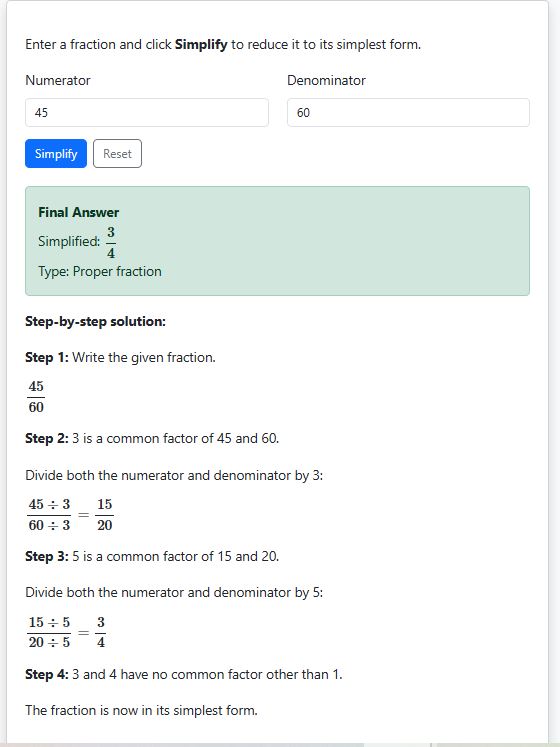
Example. Simplify 45/60
Step 1: Start with 2.
Since 45 is not divisible by 2 without a remainder, we move to the next number.
Step 2: Check whether both numerator and denominator are divisible by 3 without a remainder.
Both 45 and 60 are divisible by 3. Dividing the numerator and denominator by 3 gives:
(45 ÷3)/ (60 ÷ 3)
=15/20
Step 3: Check again whether 15 and 20 are both divisible by 2. If not, check for 3, 4, and 5
Checking 15 and 20, the next smallest number that can divide both without a remainder is 5. Thus, we divide both the numerator and denominator by 5 as follows:
(15 ÷5)/ (20 ÷ 5)
=3/4
Since no other number greater than 1 can divide both 3 and 4, the fraction is in its simplest form.
Therefore, 45/60 in its simplest form is 3/4
Want to simplify mixed fractions? Try our mixed number to improper fraction calculator, which converts mixed numbers to improper fractions in their simplest form.
Alternatively, you can use our simplifying fractions calculator to quickly find its simplest form. Simply enter 45 as the numerator and 60 as the denominator. On clicking the “simplify” button, the calculator will yield similar results as shown below:
Frequently Asked Questions
Simplifying a fraction means reducing it to its smallest possible numerator and denominator so that no number greater than 1 divides both. For improper fractions, simplifying also allows you to express them as a mixed number.
Simply enter the numerator and denominator of your fraction, then click the Simplify button. The calculator will show the fraction in its simplest form along with a step-by-step explanation of how it was simplified.
Yes! Improper fractions are simplified like any other fraction. Additionally, the calculator will show the mixed fraction equivalent if the numerator is larger than the denominator.
Absolutely. The calculator automatically handles large numerators and denominators. It shows each simplification step using small common divisors, so it’s easy to follow even for beginners.
Some fractions have several common factors between the numerator and denominator. The calculator shows each step using the smallest divisor until the fraction cannot be reduced further. This helps you understand the simplification process.
If the numerator and denominator have no common factor other than 1, the calculator will confirm that your fraction is already simplified and show it as the final answer.