This calculator converts an improper fraction into a mixed number in its simplest form. Just enter an improper fraction and click the “Convert” button to get instant results with step-by-step explanation.
Improper to Mixed Fraction Calculator
ConvertEnter an improper fraction and click Convert to get the mixed number.
Want to convert a mixed number back to an improper fraction instead? Use the mixed number to improper fraction calculator.
How to Use the Improper to Mixed Number Calculator
To convert any improper fraction to a mixed number using this calculator, follow these steps:
- Enter the improper fraction
- Click the “Convert” button
The calculator will instantly show the equivalent mixed fraction in its simplest form. You can also click the step-by-step explanation section to see exactly how your improper fraction was converted to a mixed number.
What is an Improper Fraction?
An improper fraction is a fraction where the numerator (top number) is greater than or equal to the denominator (bottom number). Every improper fraction should have at least one whole number when converted to a mixed fraction. Examples of improper fractions include , , , etc.
However, if the numerator (top number) is smaller than the denominator (bottom number), the fraction is said to be a proper fraction and cannot be converted into a mixed fraction.
What is a Mixed Fraction?
A mixed fraction (or mixed number) is a type of fraction that combines a whole number and a proper fraction. For instance, , , and are all mixed fractions because each includes a whole number and a proper fraction side by side.
Mixed fractions are more useful when dealing with measurements and quantities than improper fractions because they show the quantity more naturally. For instance, it is clearer to say cups of flour, instead of cups of flour.
How to Convert an Improper Fraction into a Mixed Number
To convert any improper fraction to a mixed number manually, follow these steps:
- Divide the numerator (top number) by the denominator (bottom number).
- The quotient (answer) becomes the whole number part of the mixed number.
- The remainder becomes the new numerator of the fraction.
- Keep the original denominator for the fractional part.
- Combine the whole number and the fraction to form the mixed number.
Example 1. Converting 13/5 into a Mixed Fraction
To convert into a mixed number by hand, follow these steps:
Step 1. Divide the numerator by the denominator
From the question:
- Numerator = 13
- Denominator = 5
Dividing 13 by 5 gives 2 remainder 3
Step 2. Identify the quotient
The quotient is the whole number you get after dividing the numerator by the denominator. In this case, the whole number is 2. Thus, this will form the whole number part of the mixed fraction.
Step 3. Find the remainder
The remainder after dividing 13 by 5 is 3. Thus, 3 will be the new numerator of the mixed fraction.
Step 4. Keep the denominator
The denominator will stay the same. Thus, the denominator for the proper fraction part will be 5.
Step 5. Form the mixed fraction
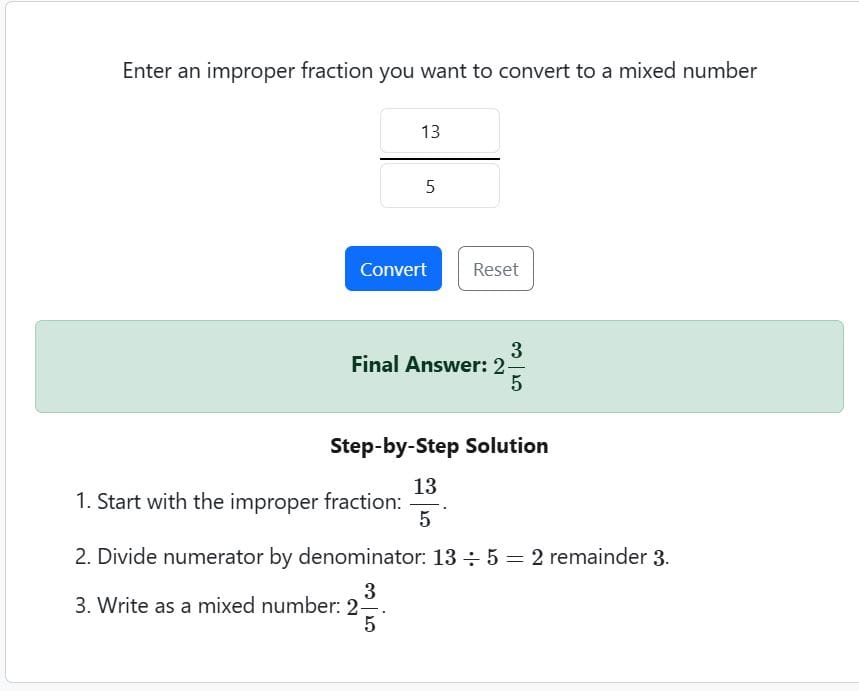
To form the mixed fraction, we combine the quotient, the remainder, and the denominator. Therefore, converting the improper fraction () to mixed number gives .
Alternatively, if you want instant results with step-by-step explanation, you only need to enter the improper fraction () into the improper to mixed fraction calculator and click convert. The calculator will instantly return similar results, as shown below.
Example 2. Converting 29/4 into a Mixed Fraction
To convert into a mixed number manually, follow these steps:
Step 1. Divide the numerator by the denominator
From the question:
Numerator = 29
Denominator = 4
Dividing 29 by 4 gives 7 remainder 1
Step 2. Identify the quotient
The quotient is the whole number you get after dividing the numerator by the denominator. In this case, the whole number is 7. Thus, this will form the whole number part of the mixed fraction.
Step 3. Find the remainder
The remainder after dividing 29 by 4 is 1. Thus, 1 will be the new numerator of the mixed fraction.
Step 4. Keep the denominator
The denominator will stay the same. Thus, the denominator for the proper fraction part will be 4.
Step 5. Form the mixed fraction
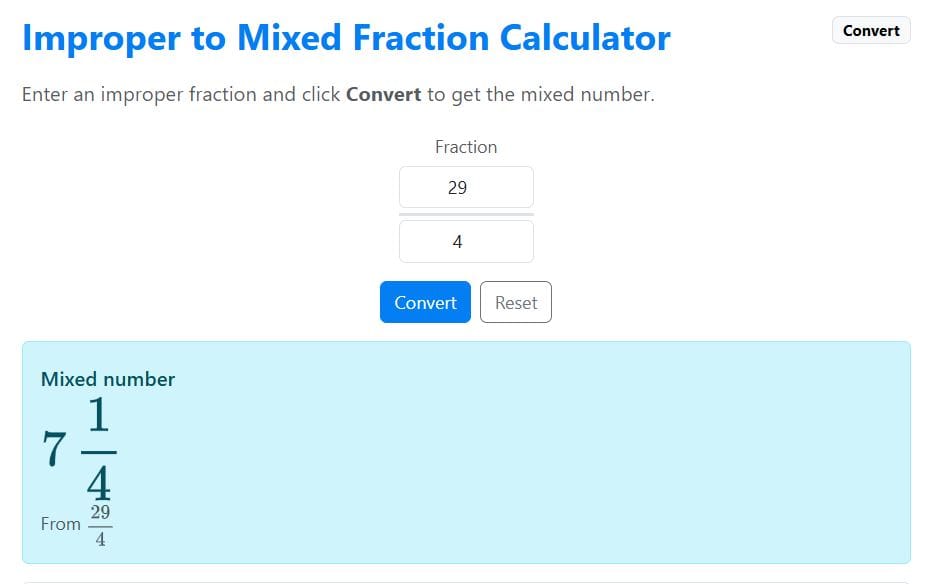
To form the mixed fraction, we combine the quotient, the remainder, and the denominator. Therefore, converting the improper fraction to a mixed number gives .
Alternatively, if you want instant results with a step-by-step explanation, you only need to enter the improper fraction into the improper fraction to mixed number calculator and click convert. The calculator will instantly return similar results, as shown below.
Frequently Asked Questions
An improper fraction is a fraction where the numerator (top number) is greater than or equal to the denominator (bottom number). For example, , , and are improper fractions because the numerator is not less than the denominator.
A mixed fraction, or mixed number, is a number made up of a whole number plus a proper fraction. It looks like or . The proper fraction part always has its numerator smaller than its denominator.
Here’s the manual method for converting any improper fraction to a mixed fraction:
– Divide the numerator by the denominator.
– The quotient becomes the whole number.
– The remainder becomes the numerator of the fraction part.
– Use the same denominator.
No. A proper fraction is already in the simplest form in terms of mixed vs improper. It has a numerator < denominator. With no whole number part, it is less than 1. Therefore, a “proper fraction” doesn’t convert into a mixed number since it doesn’t produce a whole number + fraction.
To write an improper fraction as a mixed fraction, first divide the numerator by the denominator. The whole number part of the quotient becomes the whole number in the mixed fraction, while the remainder becomes the new numerator placed over the original denominator. Finally, if the fractional part can be simplified, reduce it to the lowest terms. For example,