This calculator converts any decimal number into a fraction in simplest form. Just enter a decimal value, and it will instantly show the equivalent fraction. It also provides step-by-step working so you can see exactly how the conversion is done.
Enter the decimal number and click "Convert" to convert the decimal to fraction form. The calculator also provide step-by-step explanation.
How to Convert Decimals to Fractions Step-by-Step
Converting decimals to fractions is simple if you follow a few clear steps. Here are simple steps to follow if you need to convert non-repeating decimals to fraction:
Step 1: Write the decimal as a fraction
Start by writing the decimal number over 1.
For example, 0.75 =$ \dfrac{0.75}{1}$
Then, multiply both the numerator and denominator by 10 for each decimal place. In this case, there are two decimal places, so multiply by 100. This gives:
$=\dfrac{0.75 \times 100}{1 \times 100}$
$= \dfrac{75}{100}$
Step 2: Simplify the fraction
Find the greatest common divisor (GCD) of the numerator and denominator.
For instance, the GCD of 75 and 100 is 25. Now divide both the numerator and denominitor by the GCD. Thus, we have:
$\dfrac{75 ÷ 25}{100 ÷ 25}$
$ = \dfrac{3}{4}$
Step 3: Write as a mixed number (if needed)
If the numerator is larger than the denominator, convert it to a mixed fraction. Otherwise, leave the answer as a proper fraction. For example, if the answer is $\dfrac{11}{4}$, then you’ll need to convert it to a mixed number to get $2\dfrac{3}{4}$.
Need help converting an improper fraction to a mixed fraction? Try our improper to mixed fraction calculator.
Step 4: Confirm your answer
Do you want to confirm whether your calculations are correct? Use our decimal to fraction converter to get accurate results, along with step-by-step explanations. If you get the same fraction, then your conversion is correct. Otherwise, crosscheck your calculations.
Converting Decimals to Fractions: Worked Examples
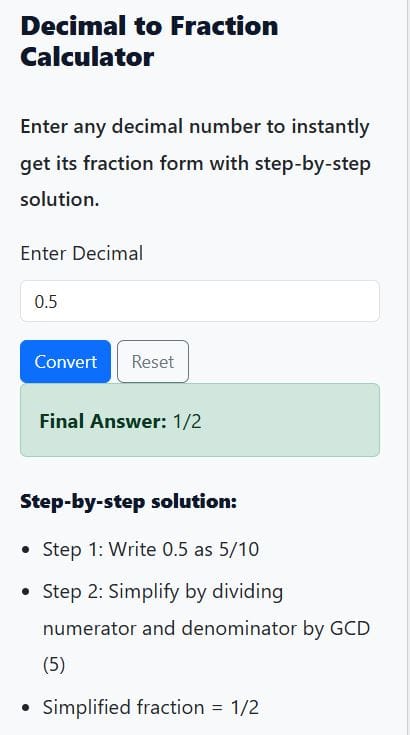
Example 1: Convert 0.5 to a fraction
- Step 1: 0.5 has one digit after the decimal → denominator is 10.
- Step 2: Write as 5/10.
- Step 3: Simplify → 1/2.
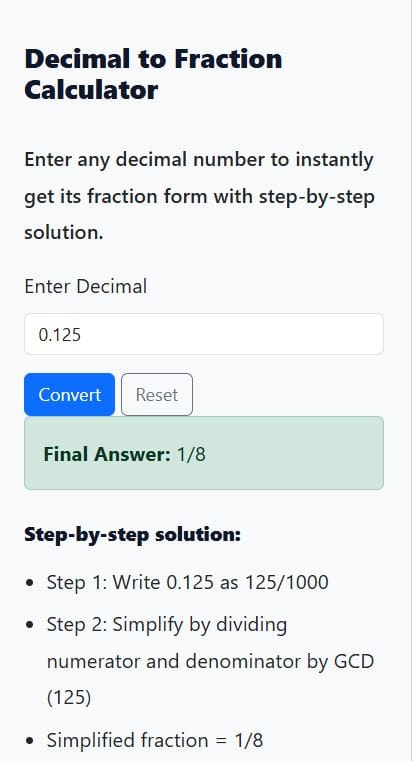
Example 2: Convert 0.125 to a fraction
- Step 1: 0.125 has three digits after the decimal → denominator is 1000.
- Step 2: Write as 125/1000.
- Step 3: Simplify → 1/8.
Want to Convert Fractions to Decimals? Use our Fraction to Decimal Calculator to instantly turn any fraction into a decimal.
Frequently Asked Questions
To convert a decimal to a fraction, write the decimal over a power of 10 (10, 100, 1000, etc.) depending on how many digits are after the decimal point. Then simplify the fraction by dividing the numerator and denominator by their greatest common divisor (GCD).
The fastest way is to use an online tool like our Decimal to Fraction Calculator, which instantly shows the fraction and step-by-step solution.
Yes. Repeating decimals can be written as fractions. For example, 0.333… equals 1/3. To make it easier, try our Repeating Decimal to Fraction Calculator.
2.5 can be written as 25/10. When simplified, it becomes 5/2 (improper fraction) or 2 1/2 (mixed fraction).
0.625 is equal to 625/1000. When simplified, it becomes 5/8.