This calculator computes the exact and cumulative probabilities of a binomial distribution, as well as the mean and standard deviation. Just enter the number of trials (n), probability of success (p), and number of successes (x) to get instant results, with a clear step-by-step explanation. The tool also provides you with a probability mass function (PMF) table, showing all the exact probabilities for your binomial experiment.
Binomial Probability Calculator
InstantEnter n (trials), p (success probability), and x (successes) to compute binomial probabilities.
How to Use the Binomial Distribution Calculator
Finding exact and cumulative binomial probabilities using this tool is very simple. You only need to follow these simple steps:
- Enter the number of trials (n) in the binomial experiment
- Specify the probability of success (p)
- Input the number of successes in the experiment
- Click Calculate
The calculator will instantly return the following probabilities:
- Exact probability: P(X=x)
- Probability of fewer than x successes: P(X<x)
- Probability of at most x successes: P(X≤x)
- Probability of more than x successes: P(X>x)
- Probability of at least x successes: P(X≥x)
Additionally, you also get the mean and standard deviation of your binomial experiment.
Want to see all the exact probabilities in one place? The calculator also generates a PMF table for the experiment.
What is a Binomial Distribution?
A binomial distribution is a probability distribution that describes the likelihood of obtaining a fixed number of successes (x) in a specified number of independent trials (n). In a binomial experiment, each trial has only two possible outcomes (success or failure), and the probability of success remains constant across trials.
Therefore, for a problem to qualify as a binomial experiment, it must fulfill the following conditions:
- The number of trials is fixed.
- Each trial is independent of the others.
- Each trial has only two possible outcomes: success or failure.
- The probability of success (p) is the same for every trial.
Binomial Distribution Formula
To calculate exact binomial probabilities, we use the binomial distribution formula. The formula is
Where:
- n is the total number of trials
- x is the number of successes
- p is the probability of success in a single trial
- (1 – p) is the probability of failure in a single trial.
Note. is read as n combination x. It represents the number of ways to choose x items from n items without regard to order. Its formula is
Also, some books represent the probability of failure, 1-p as q. In this case, the binomial formula may change slightly to
Want to learn more about the binomial distribution? Check out our complete guide here.
How to Compute Binomial Probabilities
To compute binomial probabilities, follow these steps:
- Identify the parameters, n, p, and x.
- Apply the binomial formula to calculate the exact probability:
- Compute the result by evaluating each component of the formula
Note. For cumulative probabilities, add the exact probabilities over the desired range of values
Want to learn how to find exact and cumulative binomial probabilities manually? Follow these step-by-step examples.
Example 1. Exact Probability P(X=x)
Q1. A fair coin is tossed 5 times. What is the probability of getting exactly 3 heads?
Solution
Step 1. Identify the parameters
From the question, we know that:
- Probability of success, p = 0.5
- The number of trials, n = 5, since the coin is tossed 5 times
- Number of successes, x = 3
Also, we need to find the exact probability, P(X=3)
Step 2. Apply the binomial formula
Since we have all the parameters, we need to substitute them in the binomial distribution formula.
Thus,
Step 3. Compute the result
Solving the equation in step 2 gives:
=0.3125
Therefore, P(X=3) = 0.3125
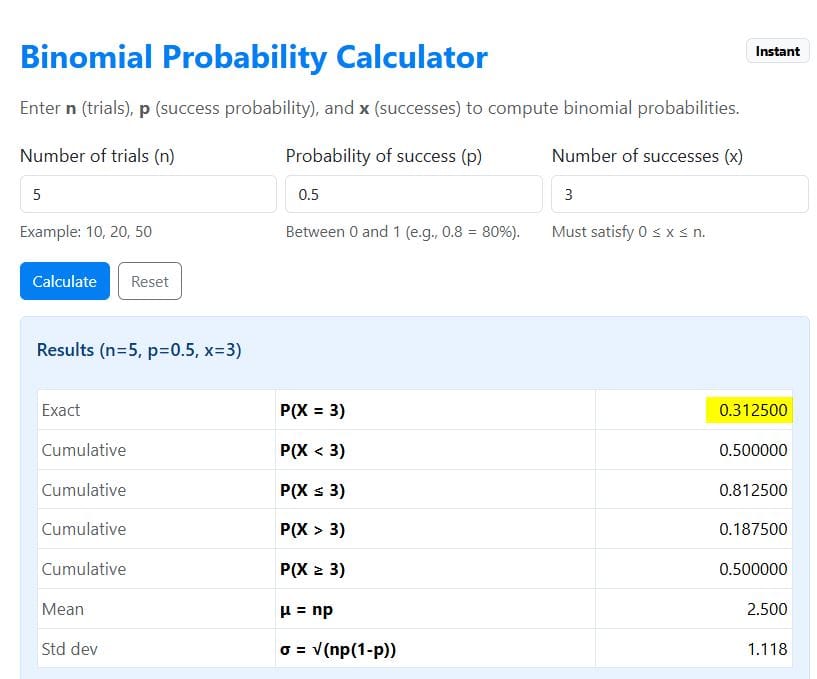
Alternatively, you can use the binomial calculator to get the same result instantly. Simply enter the values of n, x, and p, then click calculate to obtain the exact probability, as shown below.
Example 2. Probability of Fewer Than x Successes P(X<x)
Q2. A biased coin with probability of heads p=0.6 is tossed 4 times. Find the probability of getting fewer than 2 heads.
Solution
Step 1. Identify the parameters
From the question, we know:
- Probability of success, p =0.6
- Number of trials, n = 4
- Number of successes, x = 2
We need to find P(X<2)
Step 2. Apply the idea of cumulative probability
Since this is not an exact probability problem, we need to apply the idea of cumulative probability in discrete distributions.
Thus,
Note. 2 is not inclusive.
Thus, to find P(x<2), we need to find exact probabilities P(x=0) and P(x=1) and sum them.
Step 3. Compute each probability
Using the binomial formula, we need to compute exact probabilities: P(X =0) and P(X=1)
=0.0256
Also,
=4×0.6×0.064
= 0.1536
Step 4. Add the results
Thus, the cumulative probability: P(X<2) =0.0256 + 0.1536
= 0.1792
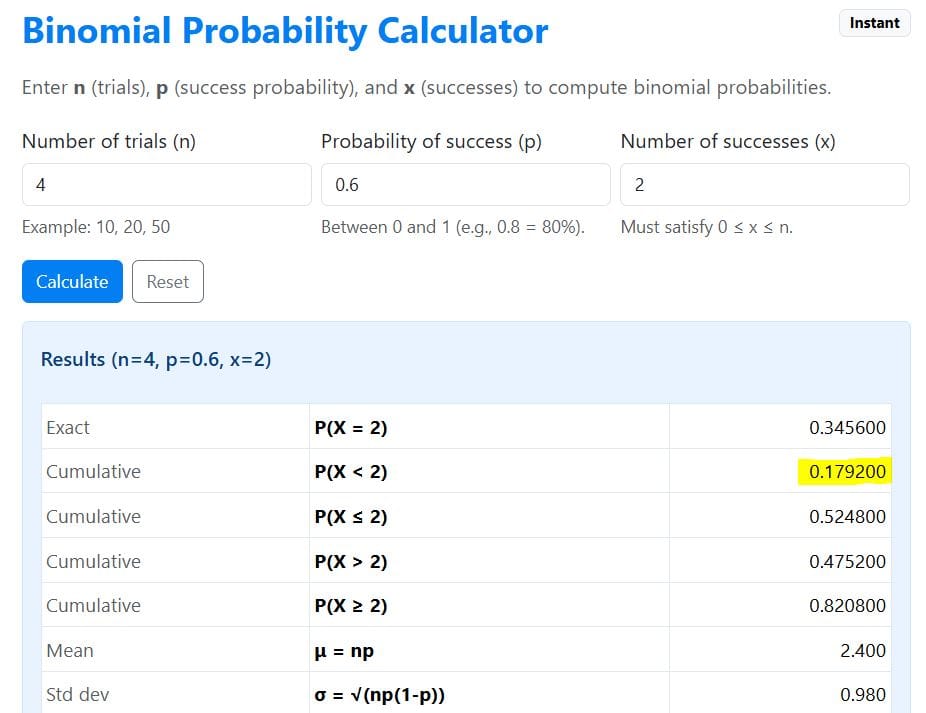
You can also find this cumulative probability quickly using the binomial probability calculator. Just enter the parameters: n = 4, p = 0.6, x = 2, and click calculate. The calculator will yield similar results, as shown below.
Want more solved binomial probability examples? Check out the detailed guide on how to calculate binomial probabilities by hand.
Frequently Asked Questions
A binomial distribution is a probability distribution that describes the number of successes in a fixed number of independent trials. Each trial has only two possible outcomes (success or failure), and the probability of success remains constant across all trials.
A binomial experiment is a process that meets four conditions:
i) There is a fixed number of trials (n)
ii) Each trial has two possible outcomes (success or failure)
iii) The probability of success (p) is the same for every trial
iv) The trials are independent
The exact probability, P(X=x), gives the likelihood of obtaining exactly x successes. On the other hand, cumulative probabilities give the likelihood of obtaining values less than x, less than or equal to x, greater than x, or greater than or equal to x.
To compute binomial probabilities using the calculator, you only need to enter the following parameters:
– Number of trials, n
– Number of successes, x
– Probability of success on a single trial, p
These values allow the calculator to compute both exact and cumulative probabilities instantly.
You can easily calculate binomial probabilities manually by applying the binomial formula: and substituting the values of n, x, and p. However, for faster results, use the binomial distribution calculator.
For a binomial distribution, the mean, also known as its expected value, is . On the other hand, the standard deviation of a binomial distribution is .