This decimal to fraction calculator helps you convert any decimal number into its equivalent fraction (proper, improper, or mixed) in its simplest form. Simply enter the decimal and click convert to get instant results with a clear, step-by-step explanation.
Free Decimal to Fraction Converter
ConverterEnter a decimal number and click Convert to get the fraction in simplest form.
Note: This calculator supports terminating (non-recurring) decimals only. If you have a repeating decimal, try our recurring decimal to fraction calculator.”
Want to quickly convert a fraction to a decimal instead? Use the fraction to decimal calculator now!
How to Use the Decimal to Fraction Calculator
Converting a non-recurring (terminating) decimal to a fraction using this calculator is simple. Just follow these steps:
- Enter the decimal number
- Click Convert
The calculator instantly returns the equivalent fraction either as a proper, improper, or mixed fraction. You can also expand the step-by-step explanation section to see how your decimal was converted to a fraction.
How to Convert a Decimal to a Fraction
Struggling with converting a decimal to a fraction manually? Follow these simple steps:
- Identify the place value of the last digit to the right of the decimal point
- Write the number without the decimal point as the numerator of the fraction
- Use the place value of the last digit to the right of the decimal point as the denominator of the fraction
- Write and simplify the fraction by dividing the numerator and denominator by their Greatest Common Factor (GCF) to reach the simplest form.
Example 1. What is 0.001 as a fraction?
Solution
To convert 0.001 to a fraction by hand, follow these steps:
Step 1. Identify the place value of the last digit to the right of the decimal point
The last digit to the right of the decimal point is 1. Its place value is thousandths
Step 2. Write the number without the decimal point as the numerator of the fraction
The number without the decimal point is 1. Thus, this becomes the numerator of the fraction
Step 3. Use the place value of the last digit to the right of the decimal point as the denominator of the fraction
Since the place value of the last digit is thousandths, the denominator of the fraction is 1000
Step 4. Write down the fraction and simplify
The fraction becomes . Since this is in its simplest form, we don’t need to simplify it further.
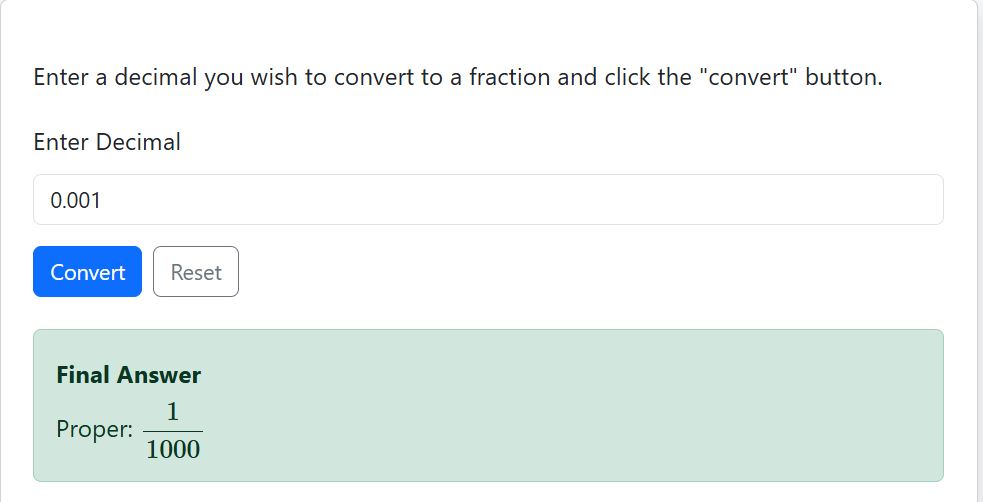
Therefore, 0.001 as a fraction is .
Alternatively, using the calculator yields similar results as shown below.
Example 2. Convert 0.5 to a fraction
Solution
Step 1. Identify the place value of the last digit to the right of the decimal point
From the decimal (0.5), the last digit to the right of the decimal point is 5. Its place value is tenths.
Step 2. Write the number without the decimal point as the numerator of the fraction
The number without the decimal point is 5, which becomes the numerator of the fraction
Step 3. Use the place value of the last digit to the right of the decimal point as the denominator of the fraction
Since the place value of the last digit is tenths, the denominator of the fraction is 10.
Step 4. Write down the fraction and simplify
The fraction is , which is not in its simplest form. In this case, we need to simplify it by dividing the numerator and denominator by the GCF. Since the GCF is 5, we divide the numerator and denominator by 5 to get .
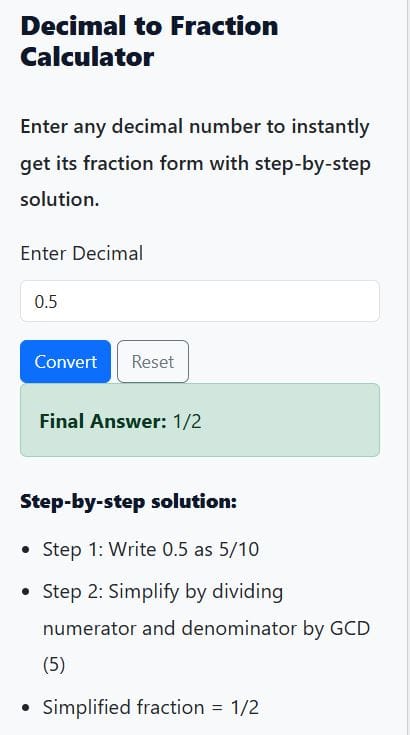
Thus, 0.5 as a fraction is . The calculator confirms the results as shown below.
Example 3. Convert 0.125 to a fraction
Solution
Step 1. Identify the place value of the last digit to the right of the decimal point
From the decimal (0.125), the last digit to the right of the decimal point is 5. Its place value is thousandths.
Step 2. Write the number without the decimal point as the numerator of the fraction
The number without the decimal point is 125. Thus, 125 will be the numerator of the fraction.
Step 3. Use the place value of the last digit to the right of the decimal point as the denominator of the fraction
Since the place value of the last digit is thousandths, the denominator of the fraction is 1000.
Step 4. Write down the fraction and simplify
The fraction becomes , which is not in its simplest form. To simplify it, we divide both the numerator and denominator by their Greatest Common Divisor/Factor. The GCD is 125. Dividing both the numerator and denominator by 125 gives .
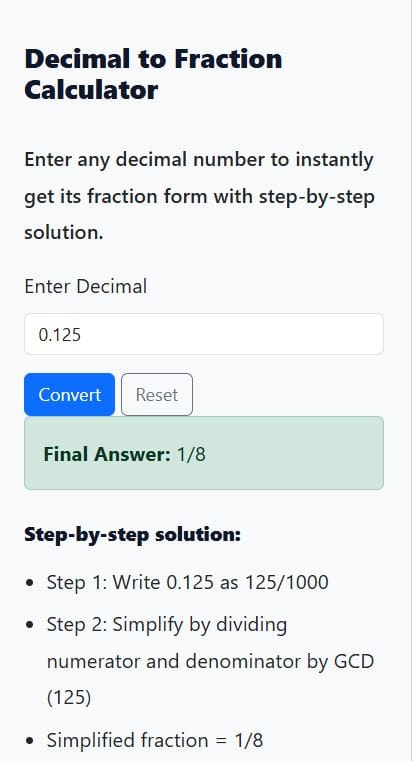
Therefore, 0.125 as a fraction in its simplest form is .
Want a quick way to simplify fractions? Try our simplifying fractions calculator.
Alternatively, entering 0.125 in the calculator and clicking the “Convert” button yields similar results as shown below.
Frequently Asked Questions
To convert a decimal to a fraction, write the decimal over a power of 10 (10, 100, 1000, etc.) depending on how many digits are after the decimal point. Then simplify the fraction by dividing the numerator and denominator by their greatest common divisor (GCD).
The fastest way is to use an online tool like our Decimal to Fraction Calculator, which instantly shows the fraction and step-by-step solution.
Yes. Repeating decimals can be written as fractions. For example, 0.333… equals . To make it easier, try our Repeating Decimal to Fraction Calculator.
2.5 can be written as . When simplified, it becomes (improper fraction) or (mixed fraction).
0.625 is equal to . When simplified, it becomes .