After computing the F-test statistic for ANOVA, regression, or the F-test for equality of variance, you need to determine whether the results are statistically significant or not. Using the classical approach, you need to find the F-critical value corresponding to your significance level (α), numerator degrees of freedom (df1), and denominator degrees of freedom (df2). In this case, you can either use the Excel F-critical value formula, the F-critical value calculator, or the F-distribution table. This article presents all the F-tables you need to compute any critical value. You’ll also learn how to read them.
What is the F-distribution Table?
An F distribution table, also known as the F-critical value table, or F table, is a statistical table that lists the critical values for right-tail F tests. Since most F-tests you’ll come across in a statistics class are right-tailed, the F-table will help you find any critical value for ANOVA, regression, or equality of variance test.
If you want to know how to read an F-table, you need to understand its components. Here are its components:
- Numerator Degrees of Freedom (df1), which are listed at the top of the table as columns
- Denominator Degrees of Freedom (df2), which are listed on the right as rows of the table
- The significance level (𝛼). Every table or section within a table has a different significance level.
- Critical F-Value. This is the value at the intersection of a specific df1, df2, and alpha level.
Common F-Distribution Tables
In this section, you’ll find the most common F-tables you can use in statistics.
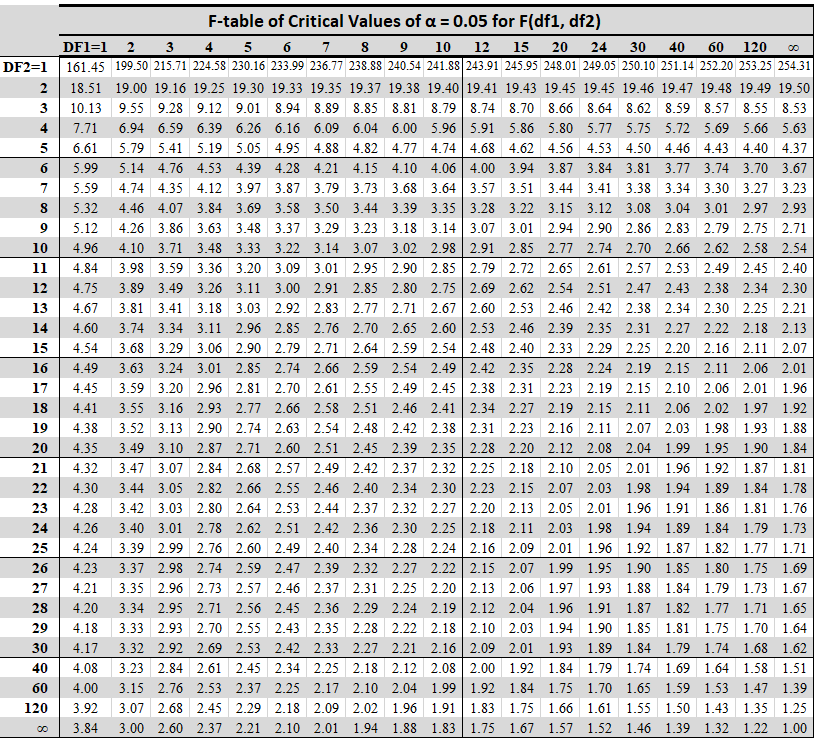
1) F-Critical Value Table for α = 0.05
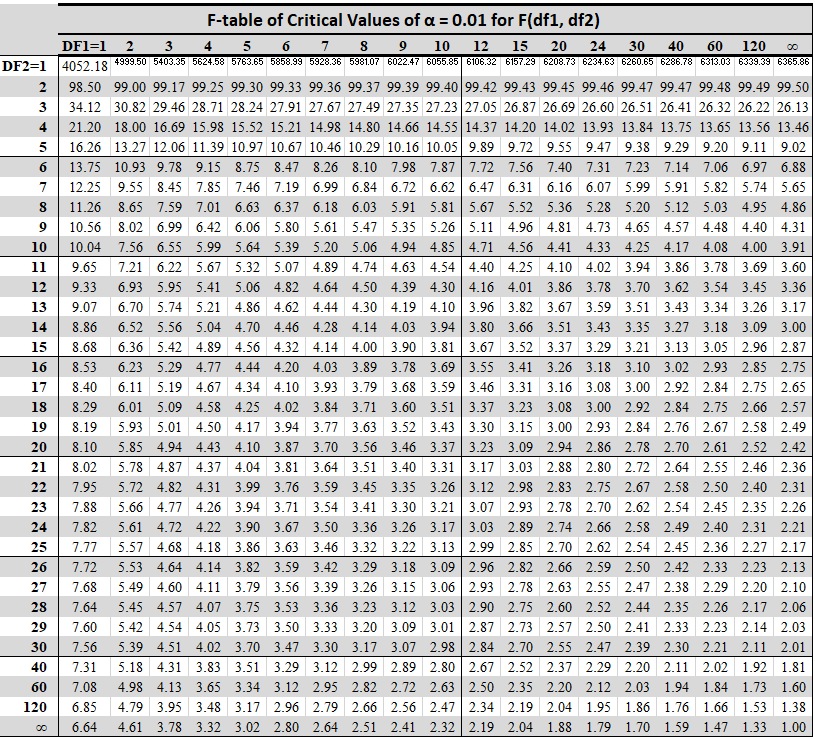
2) F-Critical Value Table for α = 0.01
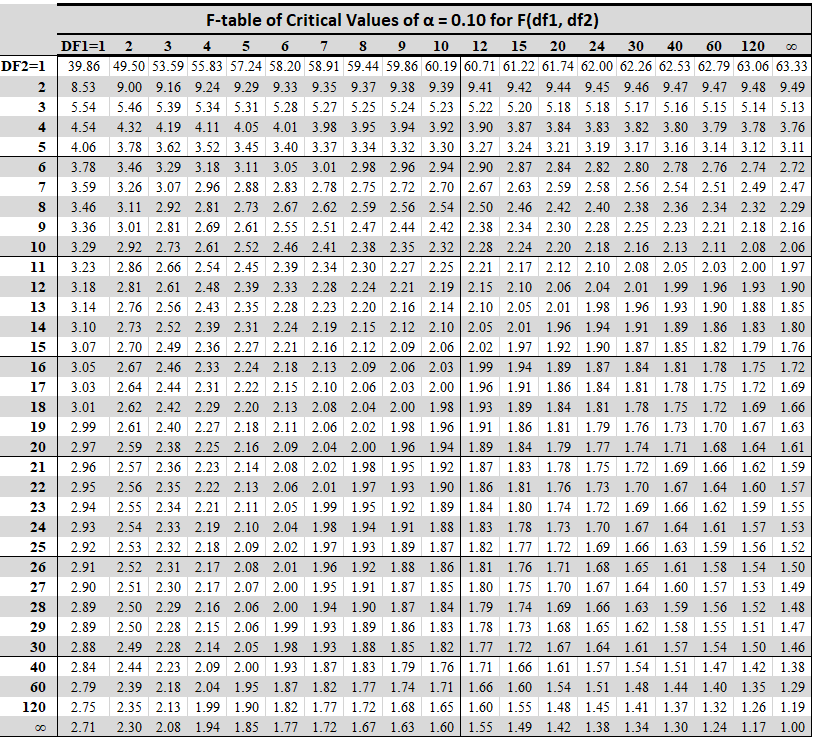
3) F-Critical Value Table for α = 0.10
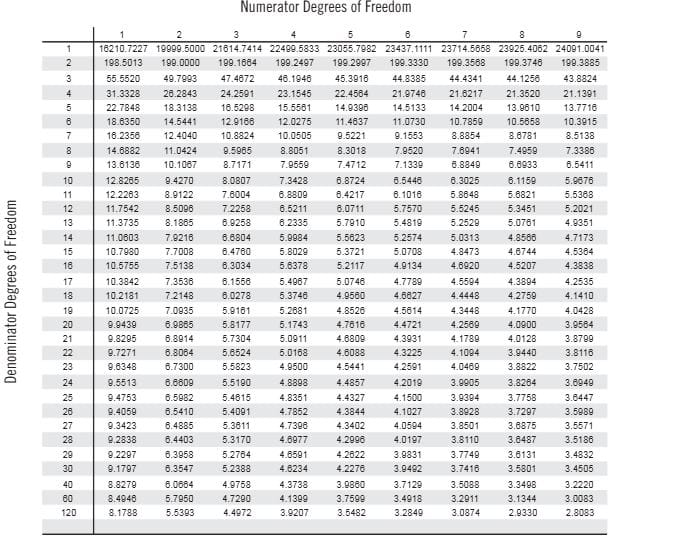
4) F-Critical Value Table for α = 0.005
5) F-Critical Table for α = 0.025
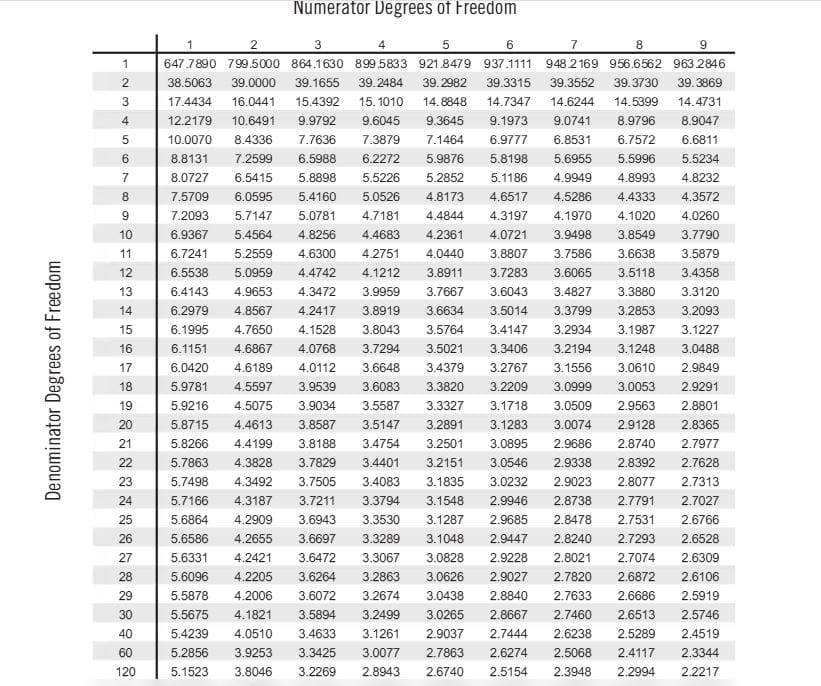
Do you prefer an F-table at all significance levels in one place? Download the F distribution table pdf version below. The pdf version supports various significance levels (α = 0.005, α = 0.01, α = 0.025, α = 0.05, and α = 0.10).
How to Read the F-Distribution Table
Want to find the F-critical value using the F-tables? Here’s how you can read the value from any F-distribution table:
- Step 1: Select an F-table with your significance level (α)
- Step 2: Locate the numerator degrees of freedom (df₁) across the top of the table
- Step 3: Locate the denominator degrees of freedom (df₂) in the left column of the table
- Step 4: Find the intersection of df1 and df2. This gives you the critical value of 𝐹𝛼, (𝑑𝑓1,𝑑𝑓2)
Example of Finding Critical F Value Using Tables
Scenario. A university administrator wants to find out whether three different training programs lead to different average job-placement test scores among final-year students. A total of 30 students are randomly assigned to the programs, with 10 students in each group. After completing the training, all students take the same standardized test. The administrator decides to analyze the results using a one-way ANOVA at a 5% significance level (α = 0.05). Find the F-critical value for this test.
Solution
To find the critical f-value for the test, we need to first identify the significance level, numerator degrees of freedom (df1), and the denominator degrees of freedom.
From the scenario, the significance level is α = 0.05. Also, since this is an ANOVA test, the degrees of freedom can be obtained as follows:
- Numerator degrees of freedom, df1 = k-1, where k is the number of independent groups. In this case, we have 3 independent groups. Thus, df1 = 3 – 1 = 2
- Denominator degrees of freedom, df2 = n-k, where n is the total sample size. From the scenario, the sample size = 30. Thus, n – k = 30-3 = 27
Next, we need to find the F-critical value from the appropriate table. Since we are testing the hypothesis at a 0.05 significance level, we need to use the F-table with a 0.05 significance level, as shown below.
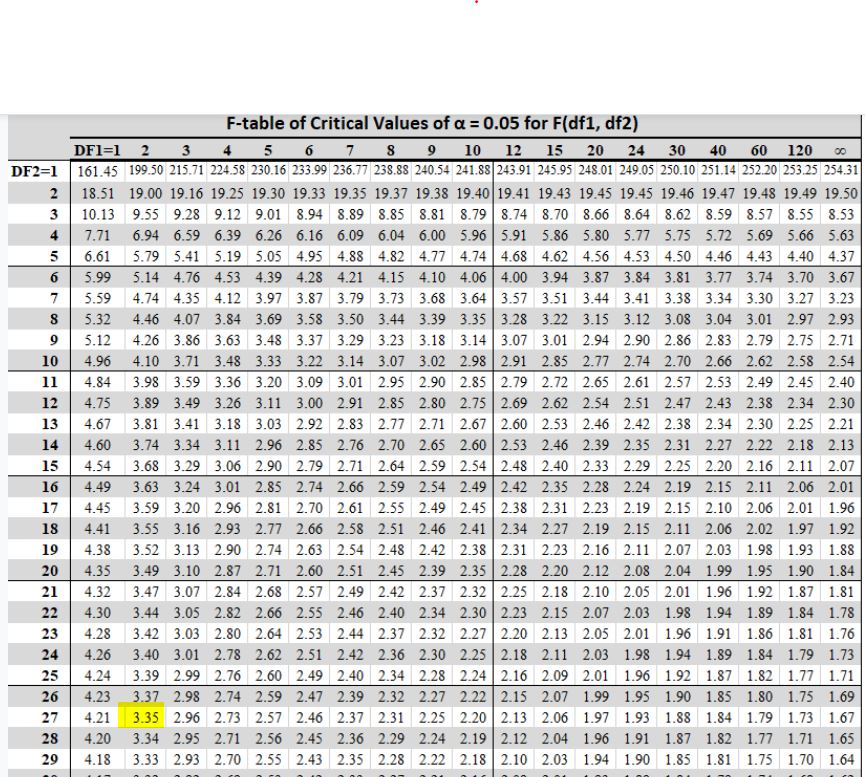
Locate the intersection of df1 = 2 and df2 = 27 from the table. This gives 3.35. Therefore, the appropriate F critical value for the test is F0.05(2, 27) = 3.35.