
A z-critical value is a cutoff point on a standard normal distribution (z-distribution) used in hypothesis testing to determine whether the results are statistically significant or not. The value is compared with the z-test statistic to determine whether to reject the null hypothesis or not. The decision is to reject the null hypothesis if the absolute value of the z-statistic is greater than the absolute z-critical value. Otherwise, you fail to reject the null hypothesis.
Given its importance in hypothesis testing, every student needs to be able to find it manually from z tables, using an online calculator, or using technologies such as Excel. Therefore, in this guide, we’ll show you how you can easily find the z-critical value given either the significance level (α) or the confidence level.
How to Find Z Critical Value: Step-by-Step
Are you struggling with finding the z critical value for hypothesis testing or confidence interval problems? Here are the four steps you should follow:
- Step 1: Identify the Significance Level (α) or confidence level
- Step 2: Determine the type of test. The test can be two-sided, right-sided, or left-sided
- Step 3: Calculate the area.
- For a two-sided test, the area is α/2
- For a right-sided test, the area is 1-α
- For a left-sided test, the area is α
- Step 4: Look up the z-critical value from the appropriate z table.
Looking for a quick and accurate strategy to find z critical value without using tables? Try the free online z critical value calculator or check out our complete guide on how to find the z critical value using Excel.
Finding Z Critical Value in Hypothesis Testing: Example Problems
In hypothesis testing, finding the z-critical value requires you to know the significance level (α) and whether the test is right-sided, left-sided, or two-sided. To help you learn how to find the correct z critical value based on the type of test, check out the following examples:
Example 1: Right-Sided Test Scenario
A beverage company claims that the average volume of its soda bottles is at least 500 ml. A quality inspector wants to test whether the mean volume is greater than 500 ml using a significance level of α = 0.05. What is the correct z critical value for this hypothesis test?
Step 1: Identify the Significance Level (α)
From the problem, the significance level is α = 0.05
Step 2: Determine the Type of Test
The alternative hypothesis involves “greater than.” In particular, we want to test the hypothesis that the mean volume is greater than 500 ml (i.e, μ > 500 ml). Thus, this is a right-sided test.
Step 3: Calculate the Area
For a right-tailed test, the area is 1-α. Thus, area = 1- 0.05
= 0.95
Step 4: Look up the Z Critical Value from a Positive Z-Table
You’ll need to look up 0.95 in the positive z table. The corresponding z value is 1.65, as shown below:
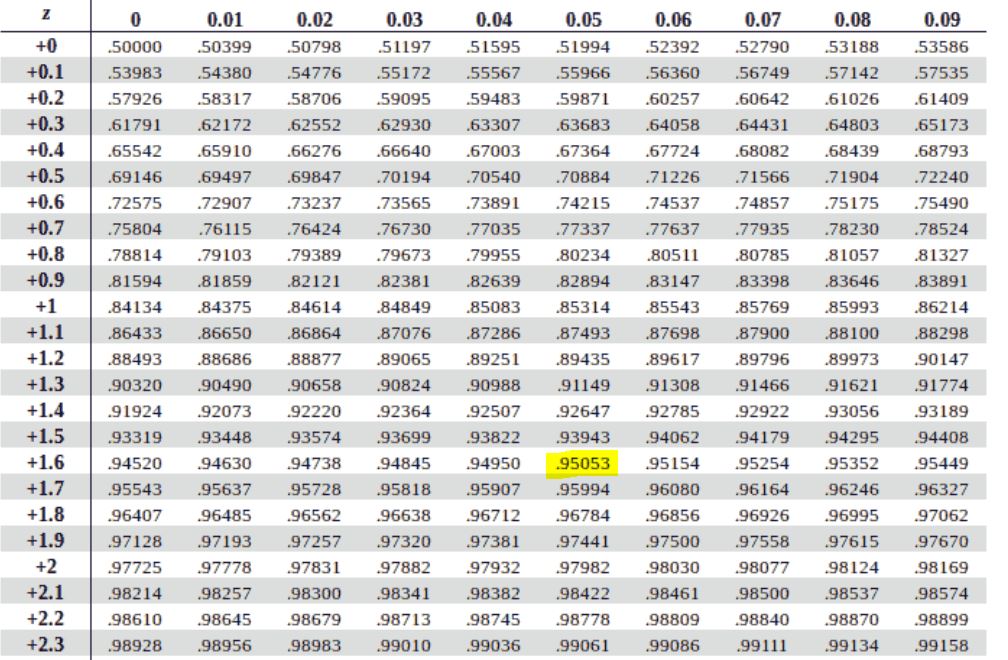
Therefore, the appropriate z critical value for the test at α = 0.05 is 1.65
Example 2: Left-Sided Test Scenario
A hospital administrator believes that the average patient waiting time in the emergency room is less than 30 minutes. To test this claim, a hypothesis test is conducted at a significance level of 0.01. What is the z critical value appropriate for this test?
Step 1: Identify the Significance Level (α)
Based on the question, we need to test the hypothesis at a 0.01 significance level. Thus, α=0.01
Step 2: Determine the Type of Test
The alternative hypothesis involves “less than.” That is, we want to test whether the average waiting time is less than 30 minutes (μ < 30). Thus, the test is a left-sided test.
Step 3: Calculate the Area
For a left-sided test, the area is α. Thus, area = α
= 0.01
Step 4: Look Up the Z Critical Value from a Negative Z Table
From the negative z-table, the z-score corresponding to a cumulative area of 0.01 is -2.33, as shown below:

Thus, the appropriate z-critical value for the test is −2.33
Example 3: Two-Sided Test Scenario
A standardized test is designed to have a mean score of 100. An education researcher wants to test whether the current population mean score is different from 100. The researcher wants to test this claim at 5% level of significance. Find the appropriate z critical values for the test.
Step 1: Identify the Significance Level (α)
Based on the scenario, the significance level is 5%. Thus, α= 0.05
Step 2: Determine the Type of Test
The alternative hypothesis is “not equal to.” In other words, we want to test the alternative hypothesis μ ≠ 100. This is a non-directional test and hence a two-sided test.
Step 3: Calculate the Area
For a two-sided test, you need to divide the area by 2. That is, area = α/2.
Therefore, the area for the two-sided test becomes 0.05/2
= 0.025.
Step 4: Look up the Z Critical Value from either a Positive or a Negative Z Table
If you want to use the positive z-table, you need to use 1-α/2 as the area.
That is, 1-α/2 = 1-0.025
= 0.975
Now, looking up the value from a positive z-table, the corresponding z value for an area of 0.975 is 1.96, as shown below:
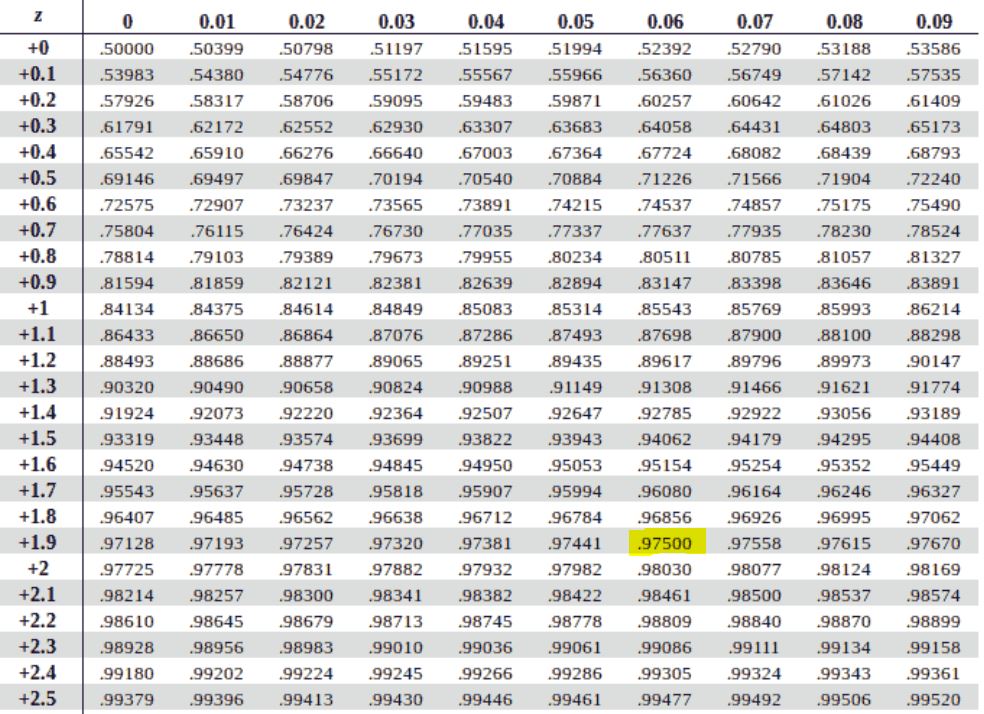
Since the standard normal table is symmetrical, the two-sided z-critical value becomes ±1.96.
Alternatively, you can use a negative z-table to get the same value. In this case, you’ll need to look up the corresponding z score of α/2.
Thus, looking up an area of 0.025 from a negative z-table gives -1.96, as shown below:
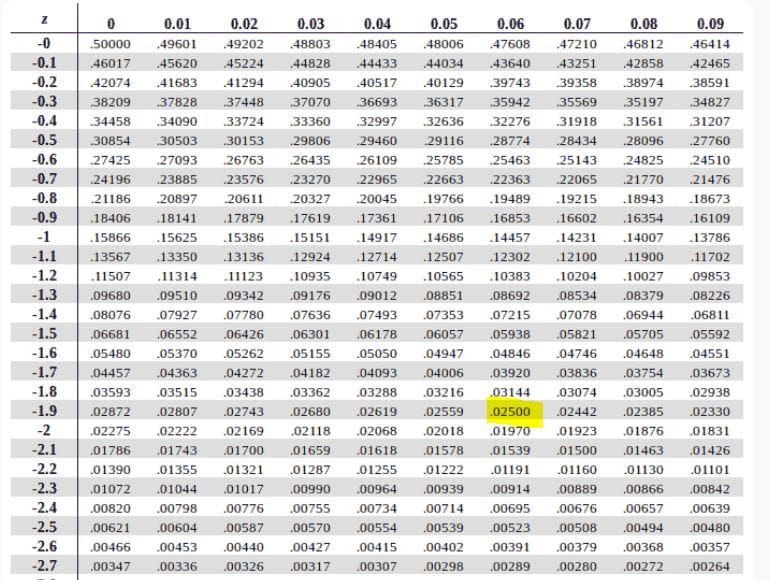
Since the standard normal table is symmetrical, the appropriate two-sided z critical value at alpha = 0.05 is ±1.96.
Finding Z Critical Value for Confidence Intervals: Example Problems
When constructing a confidence interval for a population mean (using the z distribution), the z critical value depends solely on the confidence level. Therefore, to learn how to find the appropriate z critical values for any confidence interval, consider the following examples.
Example 1. 95% Confidence Interval
A peanut manufacturer wants to estimate the mean weight of its jars of peanuts. A sample of 60 jars is collected, and the sample mean weight is 3.2 pounds. The manufacturer wants a 95% confidence interval for the true mean weight of all its peanut jars. What is the z-critical value for constructing the interval?
Step 1: Identify the Significance Level
From the scenario, we want to construct the 95% confidence interval. Thus, the confidence level is 95%. To find the significance level, we use the formula:
Significance level, α = 1-confidence level
Thus, α = 1-0.95
= 0.05
Step 2: Divide α by 2
Since confidence intervals are always two-sided, you need to divide alpha by 2.
Therefore, α/2 = 0.05/2
= 0.025
Step 3: Look Up the Z Critical Value from Either a Positive or Negative Z-Table
If using a positive z-table, find the cumulative area to the left as follows:
area = 1-0.025
= 0.975
Looking up the value from the table gives 1.96. Thus, the appropriate z critical value for the 95% confidence interval is ±1.96.
Example 2: 90% Confidence Interval
An economist wants to estimate the average weekly household expenditure on groceries in a city. A random sample is taken, and a 90% confidence interval is to be constructed for the population mean. Find the z critical value for the interval.
Step 1: Identify the Significance Level
Since the confidence level is 90%, the appropriate significance level is 1-0.90
= 0.10
Step 2: Divide α by 2
α/2 = 0.10/2
= 0.05
2α=20.10=0.05
Step 3: Look up the Z Critical Value either from the Positive or the Negative Z-table
Using the positive table, the area becomes: 1-0.05
= 0.95
Looking up 0.95 from the positive table gives z = +1.645. But since the z table is symmetrical, the z critical value for 90% confidence interval is ±1.645
Commonly Used Z Critical Values for Confidence Levels
The table below shows the most common z critical values for constructing confidence intervals at different confidence levels.
| Confidence Level | Significance Level (α) | Z Critical Value |
|---|---|---|
| 80% | 0.20 | ±1.282 |
| 85% | 0.15 | ±1.440 |
| 90% | 0.10 | ±1.645 |
| 92% | 0.08 | ±1.751 |
| 95% | 0.05 | ±1.960 |
| 96% | 0.04 | ±2.054 |
| 97% | 0.03 | ±2.170 |
| 98% | 0.02 | ±2.326 |
| 99% | 0.01 | ±2.576 |
| 99.9% | 0.001 | ±3.291 |
Frequently Asked Questions
A Z critical value is the point on the standard normal distribution that marks the boundary for rejecting or not rejecting the null hypothesis.
To find the Z critical value from a confidence level, follow these steps:
– Subtract the confidence level from 1 to get the significance level (α).
– Divide α by 2 since confidence intervals are two-sided.
– Look up the cumulative probability (1 − α/2) from a positive z table
– Left-tailed tests use a negative z value (area in the left tail).
– Right-tailed tests use a positive z value (area in the right tail).
– Two-tailed tests split α between both tails, using both the positive and negative critical values.
