This Improper Fraction Calculator helps you add, subtract, multiply, or divide improper fractions instantly. The calculator displays results in three forms: improper fraction, mixed fraction, and decimal form, giving you a complete view of your answer. It also provides a clear, step-by-step explanation, showing you exactly how the improper fractions were added, subtracted, multiplied, or divided.
Free Improper Fraction Calculator
+ − × ÷ ofEnter two improper fractions, choose an operation, then click Calculate. The result is shown as an improper fraction, a mixed number, and a decimal.
Want to convert improper fractions into mixed numbers instead? Use the Improper Fraction to Mixed Fraction Calculator instead.
How to Use the Improper Fraction Calculator
Want a quick way to add, subtract, multiply, or divide improper fractions? With our improper fraction calculator, you only need to follow these simple steps:
- Enter the first improper fraction
- Select the operator (+,-,÷, or x)
- Enter the second improper fraction
- Click Calculate to get instant results
You can also expand the step-by-step explanation section to see exactly how your improper fractions were added, subtracted, multiplied, or divided.
What is an Improper Fraction?
An improper fraction is a fraction where the numerator is greater than or equal to the denominator. This means the top number is as large as or larger than the bottom number. For example, and are improper fractions. Unlike proper fractions, which are always less than one, improper fractions can be equal to or greater than one.
Improper fractions are often used in math problems, measurements, and everyday situations. They can also be converted into mixed numbers, which combine a whole number with a fraction. Understanding improper fractions helps you add, subtract, multiply, or divide fractions more easily.
➕ How to Add Improper Fractions
When adding improper fractions, both fractions must have the same denominator. If they do not, find a common denominator before adding. Below are the steps you should follow if you want to add two improper fractions manually:
- Find the least common denominator (LCD) of the fractions.
- Convert both fractions to equivalent fractions with this common denominator
- Add the numerators together while keeping the denominator the same
- Simplify the resulting fraction or convert it into a mixed number
Example 1. Adding Two Improper Fractions
Solve the fraction:
Solution
To add , follow the steps below.
Step 1. Find the least common denominator (LCD)
The denominators are 7 and 2. The least common denominator of 7 and 2 is 14.
Step 2. Convert both fractions to equivalent fractions
Convert each fraction so that the denominator becomes 14:
For , we need to multiply both the numerator and denominator by 2, since 14 ÷ 7 = 2.
Thus,
=
Similarly, for , we need to multiply the numerator and the denominator by 7, since 14 ÷ 2 = 7
Therefore,
=
Step 3. Add the numerators
Now that both fractions have the same denominator, we add the numerators and leave the denominator the same.
Thus,
=
Step 4. Simplify or convert to a mixed number
The fraction is already in simplest form because 191 and 14 have no common factor. However, we need to convert it to a mixed number.
In this case, 191÷14=13 remainder 9
Thus, the equivalent mixed fraction is
Hence,
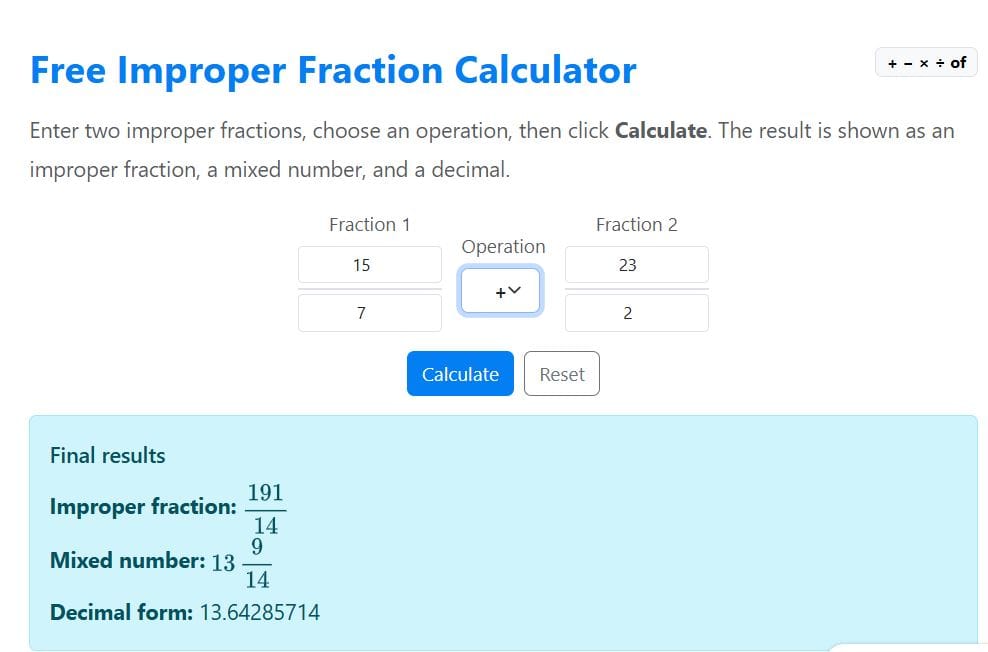
Want to confirm the results with the calculator? Just enter the two improper fractions in the calculator, select the addition operator (+), and click calculate. The calculator yields similar results as shown below.
➖ How to Subtract Improper Fractions
When subtracting improper fractions, make sure both fractions have the same denominator. If not, find the least common denominator first. In other words, to subtract two improper fractions, follow these steps:
- Find the least common denominator (LCD)
- Convert both fractions to equivalent fractions using the LCD
- Subtract the numerators and keep the denominator the same
- Simplify the result or convert it to a mixed number
Example 2. Subtracting Two Improper Fractions
Solve the fraction:
Solution
To subtract , follow the steps below.
Step 1. Find the least common denominator (LCD)
The denominators are 6 and 4. Hence, the least common denominator of 6 and 4 is 12.
Step 2. Convert both fractions to equivalent fractions
Convert each fraction so that the denominator becomes 12:
For , we multiply both the numerator and denominator by 2, since 12÷6 = 2.
Thus,
=
For , we multiply both the numerator and denominator by 3, since 12÷4 = 3.
Thus,
=
Step 3. Subtract the numerators
Now that both fractions have the same denominator, we need to subtract the numerators and keep the denominator the same.
Hence,
=
Step 4. Simplify or convert to a mixed number
The fraction is already in its simplest form. Thus, we only need to convert it to a mixed number.
Since 9÷12=1 remainder 7, the equivalent mixed fraction is
Therefore,
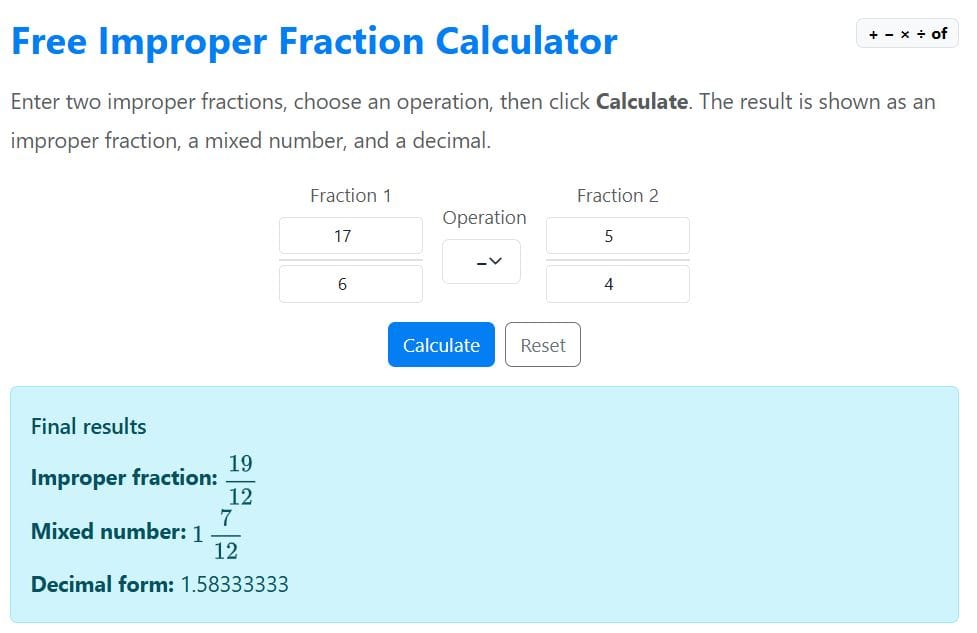
Alternatively, you can use the improper fraction calculator to find similar results. Just enter the two improper fractions, select the subtraction operator (-), and click Calculate. The calculator produces similar results, as shown below.
✖️ How to Multiply Improper Fractions
Multiplying improper fractions is usually easier than adding or subtracting because you don’t need a common denominator. Here’s how it works:
- Multiply the numerators (top numbers) together.
- Multiply the denominators (bottom numbers) together.
- Form the resulting fraction
- Simplify the resulting fraction or convert it to a mixed number
Example 3. Multiplying Improper Fractions
Solve the fraction:
Solution
To multiply , follow the steps below.
Step 1. Multiply the numerators
Multiply the top numbers (numerators): 9×7 = 63
Step 2. Multiply the denominators
Multiply the bottom numbers (denominators): 4×3 =12
Step 3. Form the resulting fraction
Combine the results to form a new fraction:
Thus,
Step 4. Simplify or convert to a mixed number
Since the fraction is not in its simplest form, we first simplify it by dividing both the numerator and denominator by their greatest common divisor (GCD), which is 3.
Hence,
=
Next, we convert this improper fraction to a mixed fraction.
Since 21÷4 = 5 remainder 1, the equivalent mixed fraction is
Therefore,
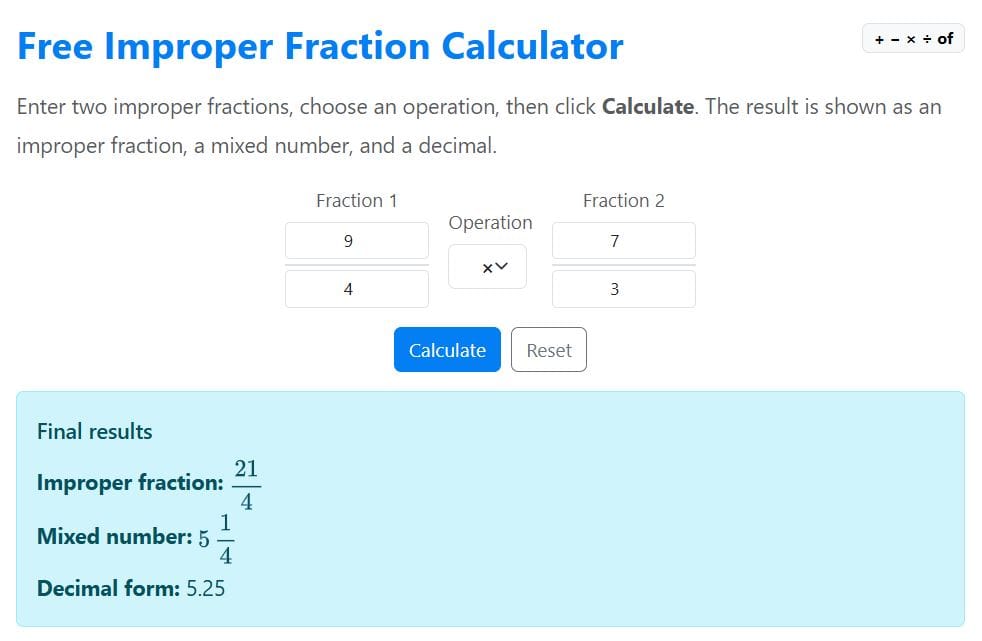
Similarly, the calculator also produces similar results. Just enter the two improper fractions, select the multiplication (X) operator, and click calculate. The results will be the same, as shown below.
➗ How to Divide Improper Fractions
To divide improper fractions, you need to find the reciprocal (flip) of the second fraction, then multiply as usual. In other words, just follow these simple steps:
- Keep the first fraction and take the reciprocal of the second
- Multiply the numerators
- Multiply the denominators
- Form the resulting fraction
- Simplify or convert to a mixed number
Example 4. Dividing Improper Fractions
Solve the fraction:
Solution
To divide , follow the steps below.
Step 1. Keep the first fraction and take the reciprocal of the second
Write down the first fraction as it is and flip the second fraction.
This gives:
Step 2. Multiply the numerators
Multiply the top numbers: 11×2 = 22
Step 3. Multiply the denominators
Multiply the bottom numbers: 3×5=15
Step 4. Form the resulting fraction
The resulting fraction after multiplying the numerators and denominators is:
Step 5. Simplify or convert to a mixed number
The fraction is already in its simplest form. Thus, we only need to convert it to a mixed fraction.
Since 22÷15 = 1 remainder 7, the resulting mixed fraction is
Therefore,
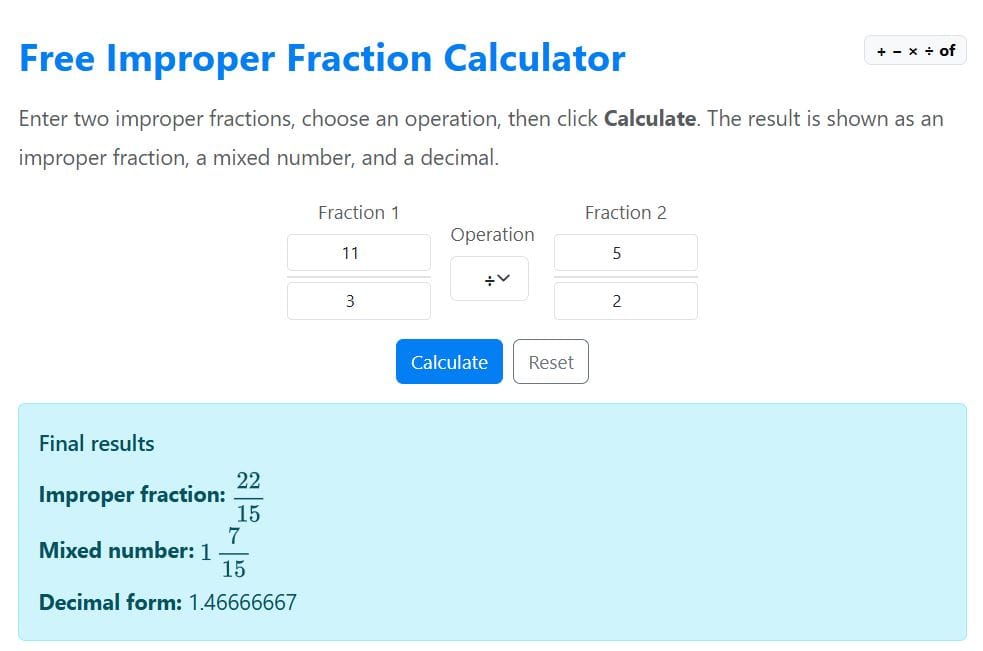
Using the calculator, we only need to enter the two improper fractions and select the appropriate operator (÷). On clicking the calculate button, the tool instantly returns similar results, as shown below.
Want to convert a mixed number into an improper fraction instead? Use the Mixed Number to Improper Fraction Calculator.
Frequently Asked Questions
The Improper Fraction Calculator lets you add, subtract, multiply, and divide improper fractions quickly. It also shows results in three forms: improper fraction, mixed number, and decimal, along with step-by-step explanations.
An improper fraction is a fraction where the numerator is greater than or equal to the denominator. For example, is an improper fraction. Generally, improper fractions can also be expressed as mixed numbers like .
The general rule for improper fractions is that the numerator must be greater than or equal to the denominator. When performing operations, always use a common denominator for addition or subtraction and multiply or divide the numerators and denominators directly for multiplication and division.
Yes. The calculator automatically simplifies fractions to their lowest terms and converts results into mixed or decimal forms for easy understanding.
Select multiplication (×) or “of” from the operation menu. The calculator multiplies the fractions and provides the result as an improper fraction, mixed number, and decimal, showing each calculation step.
Yes. After performing any operation, the calculator automatically shows the result as a mixed number along with the improper fraction and decimal.