This calculator finds the inverse of a normal distribution and returns the corresponding z score from a given probability, or a raw score for any normal distribution with a specified mean (μ) and standard deviation (σ). Enter the cumulative probability (area to the left), choose the distribution type, and the tool instantly computes the correct value.
Each result includes a clear, step-by-step explanation showing how to find the z score or raw score from the given probability.
Want to convert a z-score to a probability instead? Use the z-score to probability calculator.
How to Use the Inverse Normal Calculator
Want to quickly get a raw score or z-score from a given probability? With this tool, you only need to follow these simple steps:
- Step 1: Enter the cumulative probability. This should be a number between 0 and 1. For instance, if the probability is 86.67%, you should enter it as 0.8667
- Step 2: Choose the distribution type. If you want to get a z-score from a probability, select the standard normal distribution as the distribution type. However, if you want to get the raw score from the probability, use the default distribution type (normal distribution)
- Step 3: Enter the mean (μ) and standard deviation (σ). You only need to specify these values if you want to get a raw score from a cumulative probability.
- Step 4: Click the “Calculate” button
The calculator will instantly return the z-score (for a standard normal distribution) or raw score (for a custom distribution with a specified population mean and standard deviation). It will also provide a step-by-step explanation, showing you exactly how to find the inverse normal function to find z or the formula: X = μ+zσ to find the raw score.
Understanding the Inverse Normal Distribution
While the normal distribution works forward by converting a z-score to a probability, the inverse normal distribution works backward. In particular, it helps you find a corresponding z-score or raw x-value in a normal distribution when you already know the probability.
In other words, the inverse normal distribution solves for the value of x in the formula, P(X≤x) =p by reversing the normal cumulative distribution function (CDF).
How to Find the Z-Score From a Probability Using the Calculator
Want to find a z-score corresponding to a given probability without manual look-up from standard normal tables? Finding this value using our inverse normal distribution calculator is straightforward.
Let’s walk you through an example, step-by-step, to help you learn.
Example 1. The top 5% of students on a standardized test are considered for a scholarship. Find the z-score that separates the top 5% of students from the rest in a standard normal distribution.
Solution
The top 5% corresponds to the upper tail. Therefore, to find the required z-score, we first need to calculate the cumulative probability to the left.
We simply compute this as follows: p = 1-0.05
= 0.95
To solve this problem using the calculator, follow these steps:
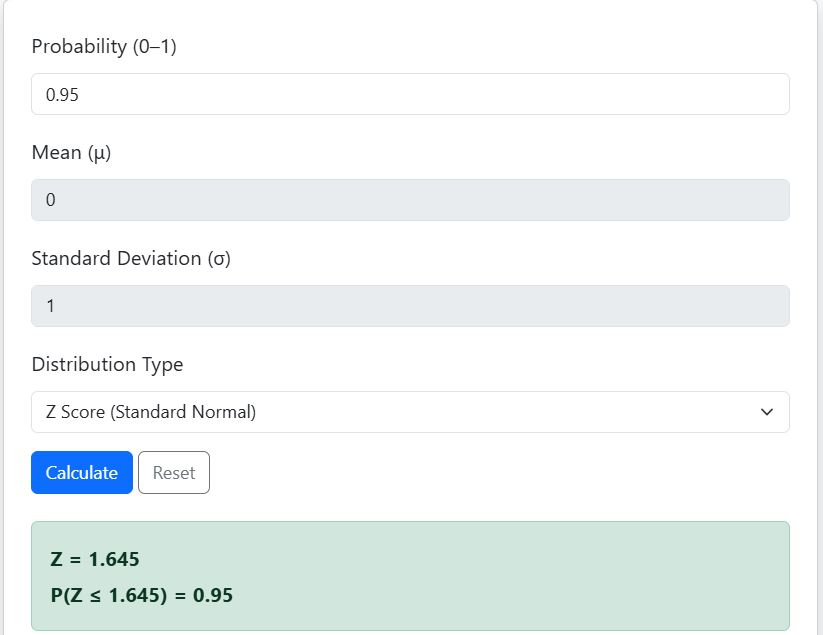
Step 1. Enter 0.95 in the probability input box
Step 2. Select Standard Normal distribution
You should select the z-score (standard normal) distribution type since we want to find z score from the probability, p = 0.95
Step 3: Click “Calculate”
The calculator applies the inverse normal function and returns the z-score as 1.645, as shown below:
Step 4: Interpret the result
A z-score of 1.645 marks the cutoff for the top 5% of students. Any student with a score above this z-score is in the top 5%, while the remaining 95% fall below it.
How to Find the X-Value (Raw Score) From a Probability Using the Calculator
The inverse normal distribution calculator also allows you to easily find the raw score (X-value) from a cumulative probability value, provided you know the population mean and standard deviation.
To help you learn how you can leverage the calculator to find the raw score, let’s walk through an example.
Example 2. In a class, the final exam scores are normally distributed with a mean of 70 and a standard deviation of 10. What is the minimum score a student needs to be in the top 10 % of the class?
Solution
From the question, we are interested in the top 10% of the class. This top 10% corresponds to the upper tail.
Thus, we first need to find the cumulative probability to the left.
The cumulative probability to the left is p = 1-0.10
= 0.90
Now, to find the appropriate x-value (raw score) using the calculator, just follow these steps:
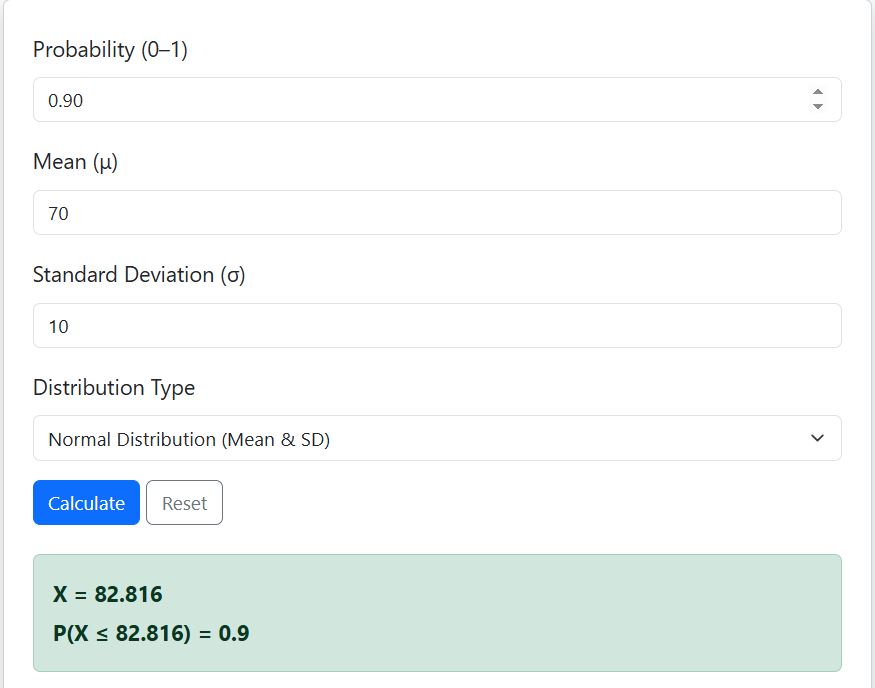
Step 1. Enter 0.90 as the probability in the calculator.
Step 2. Enter the specified population mean, μ = 70, and standard deviation, σ = 10
Step 3. Use the default distribution (Normal Distribution)
Step 4. Click the Calculate button.
The calculator will first find the z-score corresponding to the cumulative probability (behind the scenes), then convert it to the raw score using the formula: X = μ+zσ. In particular, the corresponding x-value when μ = 70 and σ = 10 is 82.816, as shown below.
Step 5. Interpret the results
Students need a score of approximately 82.82 or higher to be in the top 10% of the class.
Frequently Asked Questions
The inverse normal distribution is a statistical distribution function that helps you find a z-score or a raw score (x-value) from a given cumulative probability from a normal distribution. Instead of converting z to probability, it helps you find the z-score from probability, or the raw score (x-value) from probability.
Once you have a z-score, you can easily convert it to the original scale using the formula: X = μ+zσ.
To find a z-score using the inverse normal calculator, enter the cumulative probability into the calculator, select Standard Normal Distribution, and click calculate. The tool will instantly compute the z-score corresponding to the area to the left of a standard normal curve.
Yes! For example, if you want to find the score that separates the top 5% of students, enter 0.95 as the cumulative probability. The calculator will return the z-score and, if needed, the corresponding raw score. However, if you want a dedicated tool that converts any percentile to a z-score, you should use the percentile to z-score calculator.
If the probability is in the upper tail (e.g., the top 10%), subtract it from 1 to get the cumulative probability to the left. For example, the top 10% corresponds to p = 1 - 0.10 = 0.90.