This population mean calculator helps you quickly compute the average value of a complete population dataset. Enter data values from a population, and click calculate. The calculator will instantly return the population mean (μ) and a clear step-by-step explanation.
Free Population Mean Calculator
DescriptiveEnter numbers separated by commas, spaces, or tabs, or paste values directly from Excel to calculate the population mean (μ).
Want to find the mean of a set of sample observations instead? Use the free sample mean calculator for instant results with a clear, step-by-step explanation.
How to Use the Population Mean Calculator
Want to quickly find the average of all the observations in the complete population? This calculator offers instant results. Just follow these two simple steps:
- Step 1. Type or paste the population data in the input box. The calculator accepts numbers separated by commas, spaces, or line breaks. You can also paste values directly from Excel.
- Step 2. Click the “Calculate” button
The calculator will instantly compute the average of the population data (μ). You can also expand the step-by-step explanation to see how the mean was computed for your data.
What is the Population Mean?
The population mean is the average value of all observations in an entire population. In statistics, it represents the central value of a complete dataset. The population mean symbol is the Greek letter μ, which is read as “mu”.
Note. You should only calculate the population mean if you have data for every member or observation in the target population. Otherwise, use the sample mean.
An example of population data is a record of the test scores of every student in a class. In this case, if your target population is all students in this class, then the average of these scores represents the population mean.
Tip. While the sample mean estimates the population average, the population mean represents the true average of the entire population.
Population Mean Formula
The formula for finding the population is μ = ∑Xi/N
Where:
- μ is the population mean
- ∑Xi is the sum of all values in the population
- N is the total number of observations in the population
How to Find the Population Mean
Finding the population mean simply means calculating the average of all observations in that population. Just follow these simple steps:
- Sum all values in the population to get ∑Xi
- Count the total number of observations in the population to get N
- Divide the sum of all values by the total number of observations in the population to get the population mean (μ).
Example
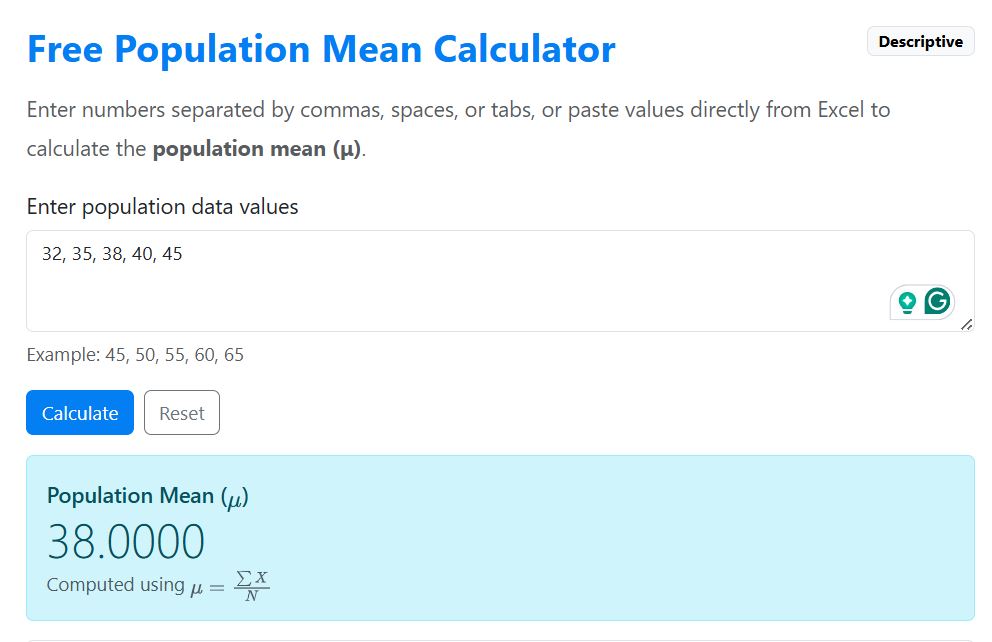
Suppose a researcher records the monthly sales (in units) for a small store across five months. The values represent the entire population for the period being analyzed. The values are: 32, 35, 38, 40, 45. Find the population mean.
Solution
To find the population mean for this data, follow these steps:
Step 1. Sum all values in the population
The sum of all values is: ∑Xi =32+35+38+40+45
=190
Step 2. Count the total number of observations in the population data
The total number of observations in the data is 5. Hence, N = 5
Step 3. Divide the sum of all values by the total number of observations
The population mean, μ = sum of all values (∑Xi)/total number of observations (N)
=190/5
= 38
Therefore, the population mean is 38 units.
Alternatively, you can instantly compute the population mean using the calculator. Simply copy and paste the data into the calculator and click the calculate button. The calculator yields similar results as shown below.
Population Mean vs Sample Mean
The population mean and the sample mean both measure the average value of a dataset.. However, they are used in different situations. The population mean describes the average of all values in a population, while the sample mean estimates the average based on a subset (sample) of the population.
You should use the population mean when the data from the entire population is available. However, if collecting data from the whole population is impractical, you need to collect a subset of the data and compute the sample mean.
The table below summarizes the key differences between population mean and sample mean.
| Feature | Population Mean | Sample Mean |
|---|---|---|
| Symbol | μ | x̄ |
| Data used | Entire population | Sample of population |
| Formula denominator | N | n |
| Use case | Census data | Statistical inference |
Limitations of the Population Mean
While the population mean provides the exact average of a dataset, it is not always practical to calculate in real-world studies.
Key limitations include:
- Requires complete population data. You must have values for every member of the population.
- Often impractical for large populations. Collecting data from very large populations can be costly and time-consuming.
- Researchers often rely on samples. In most studies, statisticians calculate the sample mean as an estimate of the population mean.