This Slovin’s formula calculator computes the minimum sample size for your study, given the population size (N) and the desired margin of error (e). It also provides a clear, step-by-step explanation showing exactly how the sample size was calculated.
Slovin’s Formula Calculator
sample sizeEnter your population size and margin of error to estimate the minimum sample size using Slovin’s formula.
How to Use Slovin’s Sample Size Calculator
Finding the minimum sample size for your study using Slovin’s calculator is simple and straightforward. You don’t need to apply Slovin’s formula manually. Just follow these 3 steps for instant results:
- Enter the population size (N)
- Enter your desired margin of error (e) as a decimal.
- Click Calculate.
The calculator will apply Slovin’s formula and instantly return the minimum sample size (n) you need to sample. You can also expand the step-by-step explanation section to see how the calculator applied the formula and your parameters to get the sample size.
What is Slovin’s Formula?
Slovin’s formula is a major sample size determination formula used to estimate the minimum sample size for a study, given the population size (N), and the desired margin of error (e). The formula is n = N/(1+Ne2)
Where:
- n is the minimum sample size for your study
- N is the size of the target population
- e is the desired margin of error
Instead of surveying the entire population, Slovin’s sample size formula helps researchers determine the minimum number of respondents required to achieve reliable results. It is ideal for determining the sample size when the population size (N) is known, but little to nothing is known about the behavior or variability of the population. The formula is mainly used for quick, simple, and preliminary studies.
Slovin’s formula was introduced by Slovin in 1960 and has since become a common method for sample size determination in academic and professional research.
When to Use Slovin’s Formula?
Knowing when to use Slovin’s formula is important for applying it correctly in research. This formula is especially useful when you have a known population size but cannot survey every individual. Some of the common situations where you can use the formula include:
- Surveys and questionnaires: For example, when researchers want to collect opinions from a large group, but need only a representative sample.
- Population studies: When studying communities, schools, or organizations where the total number of members is already known.
- Academic research projects: Students often use Slovin’s formula to quickly estimate sample size for theses and dissertations.
However, Slovin’s sample size formula is associated with a number of limitations, which include:
- It works best as a quick estimation method rather than a precise statistical tool.
- It assumes random sampling, which may not always be possible in real-world studies.
- It does not consider population variability or standard deviation.
How to Calculate Sample Size Using Slovin’s Formula: An Example
Imagine you are conducting a survey in a town with 2,000 residents, and you want to know people’s opinions about a new community project. Since it is not realistic to ask every resident, you decide to use Slovin’s formula to find the right sample size. You also choose a margin of error of 4% (0.04) to keep results accurate. Calculate the appropriate sample size.
Solution
From the question, we know that the population size, N = 2000, and the margin of error, e = 0.04.
Here’s how to find the minimum sample size for the study.
Step 1. Write down Slovin’s sample size formula
By definition, the formula is n = N/(1+Ne2)
Step 2. Substitute the known values in the formula and solve the equation for n
Substituting the values in the formula, we have:
n = 2000/(1+2000*(0.04)2)
Solving the equation for n gives:
n = 2000/(1+3.2)
= 2000/4.2
=476.19
Since the sample size must be a whole number, we round up the value. This gives n = 477
This means that you need to select at least 477 respondents from the total population of 2,000 individuals to ensure that the results are representative of the target population.
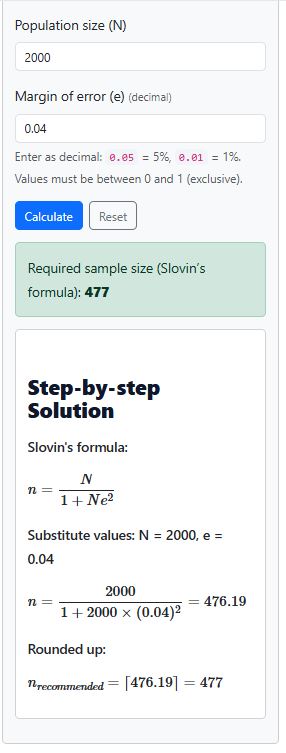
Alternatively, you can quickly find the value using Slovin’s sample size calculator. Just enter the population size (N = 2000) and the margin of error (e = 0.04). The calculator instantly computes the minimum sample size and yields similar results, as shown below.
Frequently Asked Questions
Slovin’s formula is a statistical method used to determine the minimum sample size needed from a population. It ensures that your survey or study results are accurate while keeping the sample size manageable.
The Slovin’s sample size calculator quickly computes the number of samples required for a given population. By entering your population size and margin of error, it provides the minimum sample size along with a clear step-by-step calculation using Slovin’s formula.
You should use Slovin’s formula when the population size is known, random sampling is possible, and you want a quick estimate of the sample size. It is most common in surveys, academic research, and basic population studies.
The Slovin’s sample size formula is: n= N / (1+Ne2)
Where:
– n is the required sample size
– N is the total population, and
– e is the margin of error.
The calculator automatically applies this formula for accurate results.
Common choices are 5% (0.05) or 1% (0.01), depending on how precise you want your results. A smaller margin of error requires a larger sample size.
Slovin’s formula is simpler and used for quick estimates when the population size is known. On the other hand, Cochran’s formula is more advanced and takes variability into account, making it better for detailed research.