Z Score: Definition, Formula, Calculation & Interpretation
A z score is a statistical measure that shows how many standard deviations a value is from the mean of a dataset. Simply stated, a z score tells you whether…
Learn statistics through clear guides, worked examples, formulas, assumptions, interpretation, and practical reporting advice.
A z score is a statistical measure that shows how many standard deviations a value is from the mean of a dataset. Simply stated, a z score tells you whether…
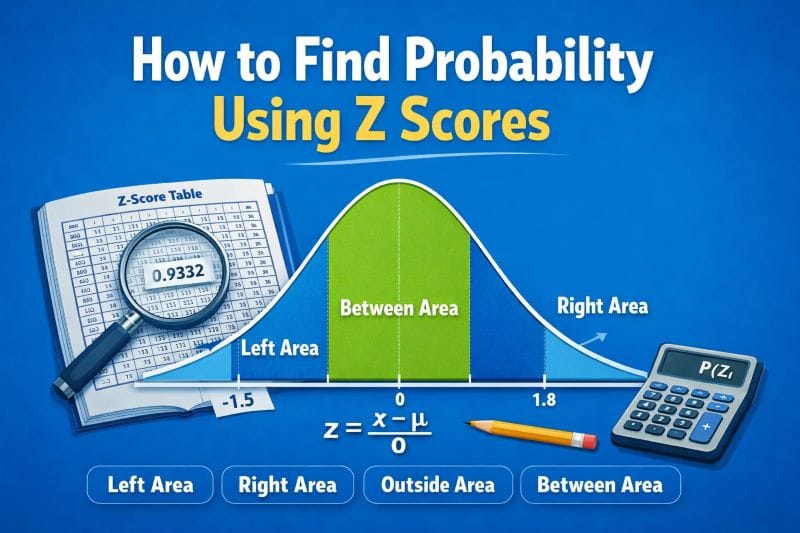
Calculating a z-score is always straightforward. You only need to apply the formula, z =(x−μ)/σ. However, finding probability with a z-score is quite challenging for many students. There are many…
In statistics, a z-score is a standard score that indicates how many standard deviations a data point is from the mean. For instance, a z value of -2 means that…
When conducting quantitative research and intend to collect primary data using survey questionnaires, you'll be required to determine the minimum sample size for your study. Sample size determination helps ensure…
A z-critical value is a cutoff point on a standard normal distribution (z-distribution) used in hypothesis testing to determine whether the results are statistically significant or not. The value is…
The binomial distribution is a discrete probability distribution commonly used to model situations where an experiment is repeated a fixed number of times and each trial has only two possible…
A Z Score Table, also called a Standard Normal Table, shows the probability of a value occurring below a specific z-score in a standard normal distribution. It helps you find…