
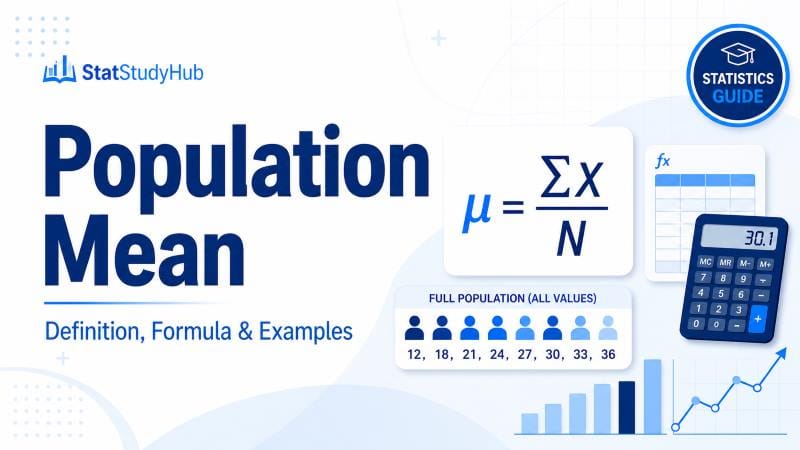
The population mean is the average value of all observations in the entire group you want to study. You use it when your data includes every member, item, score, or observation in your target population. In this guide, you will learn what the population mean is, its symbol and formula, and how to find the population mean by hand in 3 simple steps. We will also look at how the population mean differs from the sample mean and common mistakes to avoid when calculating it.
What Is the Population Mean?
The population mean is the average of all values in the entire group you want to study. In statistics, a population refers to the full set of people, items, scores, or observations under investigation.
A population can be small or large. For example, it could include:
- All students in one classroom
- All employees in a company
- All test scores in one completed exam
- All products made in a factory in one day
- All monthly sales values for a business in one year
The key idea is that every value in the group you are studying should be included.
For example, suppose a class has 8 students. If you calculate the average score using the scores from all 8 students, you have found the population mean for that class.
In statistics, the population mean is called a parameter because it describes the entire group rather than a selected part of it.
Population Mean Symbol and Formula
The population mean symbol is the Greek letter μ, pronounced mu.
This is different from the sample mean symbol, x̄, which is commonly read as x-bar. The different symbols help you tell whether a mean represents the entire population or only a sample.
The population mean formula is: μ = Σxᵢ / N
Where:
- μ is the population mean
- Σxᵢ is the sum of all values in the population
- N is the total number of values in the population
In simple terms, the formula tells you to add all the values in the group and divide the total by the number of values.
The formula is similar to the sample mean formula, except for the notation. The sample mean uses x̄ for the mean and n for the sample size, while the population mean uses the μ symbol and N for the sample size.
How to Find the Population Mean by Hand
To calculate the mean of a population manually, follow these steps:
- Add all values in the population to get Σxᵢ.
- Count the number of observations to get N.
- Divide the sum of all values by the population size to get μ.
Let’s use an example.
Example
Suppose the scores of all 5 students in a small class are: 72, 80, 85, 90, 93. Find the mean.
Solution
Since the data includes the score of every student in the class, we need to find the population mean.
Step 1. Sum all the values
Adding all the values, we get:
Σxᵢ = 72 + 80 + 85 + 90 + 93
= 420
Thus. Σxᵢ = 420
Step 2. Count the number of observations
There are 5 students in the class. Thus, the population size, N = 5
Step 3. Divide the sum by the population size
Recall that the population mean formula is: μ = Σxᵢ / N
Substituting the values from Steps 1 and 2, we get: μ = 420 / 5
= 84
Therefore, the population mean, μ = 84. This means that the average score for the whole class is 84.
Want to check your answer or calculate a larger dataset? Use our Population Mean Calculator to enter or paste your values and get the population mean with a step-by-step solution.
Population Mean vs Sample Mean
The population mean and sample mean are closely related, but they are not the same.
A population mean includes every value in the group you want to study. A sample mean, on the other hand, is calculated using only some of the values from that population.
The table below summarizes the main differences.
| Feature | Population Mean | Sample Mean |
|---|---|---|
| Meaning | Average of the entire population | Average of a sample from the population |
| Symbol | μ | x̄ |
| Number of values | N | n |
| Type | Parameter | Statistic |
| Example | Average score of every student in a class | Average score of selected students in a class |
For example, suppose a class has 30 students. If you calculate the average score of all 30 students, you have found the population mean. However, if you select only 10 students and calculate their average score, you have found the sample mean.
Is Population Mean the Same as Average?
Yes. The population mean is a type of average. It gives you the arithmetic average of all values in a complete population.
In everyday language, people often use the word average to mean the arithmetic mean. In statistics, however, it is important to know whether the average was calculated from the entire population or from a sample.
For example, if you calculate the average age of every employee in a company, you have found the population mean.
If you calculate the average age of only selected employees, you have found the sample mean.
Sometimes, you may simply want to find the average of a dataset without worrying about whether the values represent a sample or population. In that case, you can use our arithmetic mean calculator.
Common Mistakes When Finding the Population Mean
Finding the population mean is simple, but a few small mistakes can give you the wrong answer.
Here are some common mistakes to avoid:
- Using sample data instead of the entire population. If the data only includes part of the group you are studying, you are working with a sample.
- Leaving out some values. When calculating the population mean, all values in the population should be included.
- Confusing μ and x̄. Use μ for the population mean and x̄ for the sample mean.
- Dividing by the wrong number. Divide the sum of all values by the total number of observations in the population.
- Confusing N and n. N is commonly used for the population size, while n is used for the sample size.
Limitations of the Population Mean
Although the population mean gives you the exact average of a population, it is not always practical to calculate it.
Some of the main limitations include:
- You need data from the entire population. Every observation in the target group should be available.
- It can be difficult for large populations. Collecting information from every member of a large population can take a lot of time and money.
- Complete population data may not be available. In many studies, researchers collect a sample and use the sample mean to estimate the population mean.
This is why sample data is commonly used when studying large populations.
Frequently Asked Questions
The population mean is the average of all values in the entire group you are studying. It describes the average value of the complete population.
The symbol for the population mean is μ, pronounced mu.
The population mean formula is μ = Σxᵢ / N, where Σxᵢ is the sum of all population values, and N is the total number of observations.
Add all values in the population to get Σxᵢ, count the number of observations to get N, then divide the sum by the population size.
