
Use this p-value from z calculator to quickly find the left-tailed, right-tailed, or two-tailed p-value for any Z test. Simply enter the z-score value, select the type of test (left, right, or two-tailed), and enter the significance level (α). On clicking the calculate button, the calculator will instantly return the correct p-value for the type of test you selected and tell you whether to reject or fail to reject the null hypothesis.
The calculator also provides a clear, step-by-step explanation of how the p-value was calculated for your z statistic.
Step-by-step solution
Want a tool that computes p-values for any distribution (say F, r, T, Z, and chi-square) all in one place? Use the p-value calculator instead.
How to Use the P Value From Z Score Calculator
Finding the p-value from a z score (z test statistic) using the calculator is quick and simple. Just follow these simple steps:
- Enter the z-statistic value
- Select the type of test you’re conducting (Right-tailed, Left-tailed, or Two-tailed)
- Enter the significance level (α) for your hypothesis test
- Click Calculate
The calculator will instantly return the correct p-value for your selected type of test in bold, compare the p-value with your significance level, and tell you whether to reject the null hypothesis or not. It will also provide you with a clear, step-by-step explanation, showing you exactly how the p-value was calculated and interpreted for your z-statistic value.
To help you learn how to use the calculator to find the left, right, or two-tailed p-values for your z tests, let’s walk you through several examples.
Example 1. Find P-Value for a Left-Tailed Test
Suppose a researcher is conducting a one-sample z-test to check if the proportion of students passing an exam is less than 70%. The test statistic is z = -1.50. Find the appropriate p-value for this test (Assume a 5% level of significance).
Solution
Here, we need to test the hypotheses:
H0: p = 0.70
H1: p < 0.70
Since the alternative hypothesis has a “less than” symbol, this is a left-tailed test. Therefore, to find the p-value for this test using the calculator, follow these steps:
- Enter -1.50 in the z-score input field
- Select left-tailed as the Test type
- Enter 0.05 in the significance level
- Click Calculate
From the calculator results, the left-tailed p-value for the test is 0.066807, as shown below.
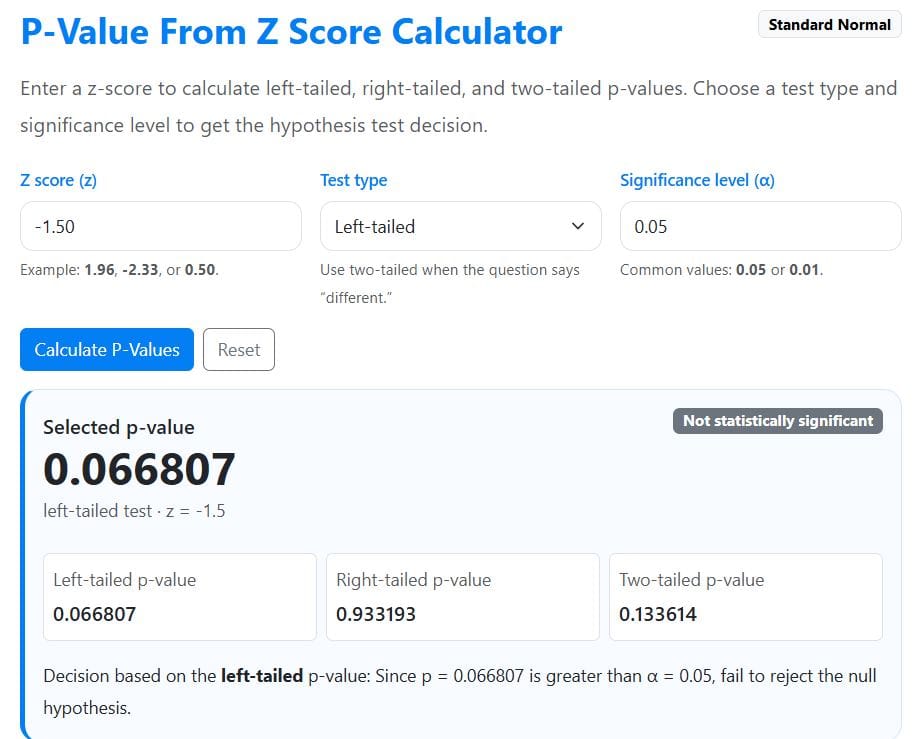
As you can see, the calculator also tells you that since the p-value is greater than the significance level (0.05), we fail to reject the null hypothesis.
Example 2. Find P-value for a Right-Tailed Test
A company claims its new battery lasts at least 100 hours. You collect sample data and calculate a z-test statistic = 2.33 to check if the battery lasts more than 100 hours. Find the appropriate p-value for this test. (Assume a 5% significance level)
Solution
In this case, we need to test the hypotheses:
H0: μ = 100 hours
H1: μ > 100 hours
Since the alternative hypothesis has a “greater than” sign, this is a right-tailed test. To find the correct p-value for this test using the calculator, follow these steps:
- Enter 2.33 in the z-score input field
- Select right-tailed as the test type
- Enter 0.05 in the significance level input field
- Click calculate
The calculator instantly returns the right-tailed p-value in bold as 0.009903 (see the figure below).
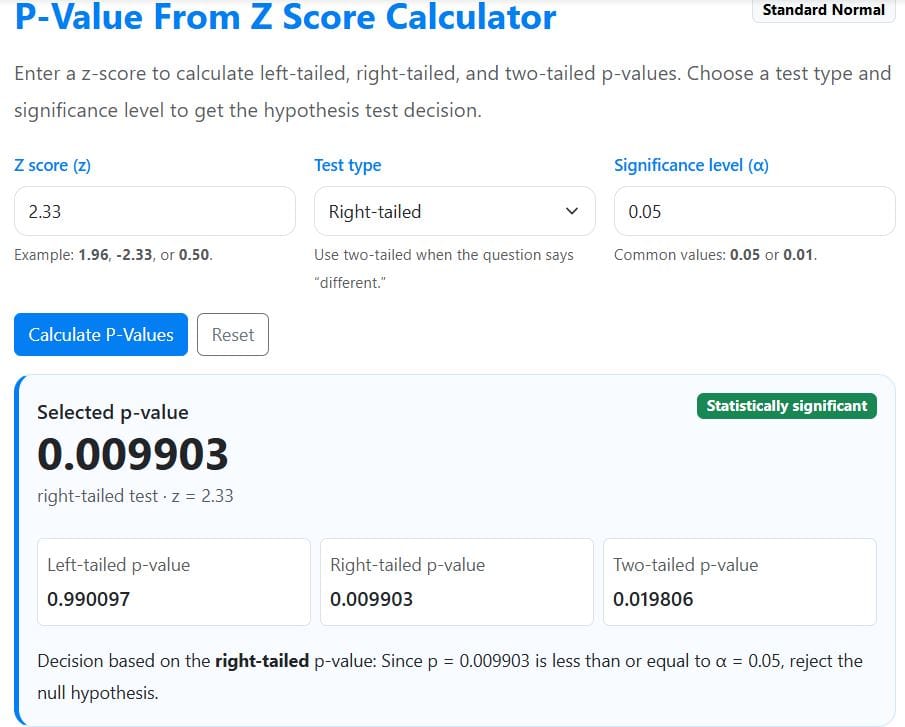
As you can see from the above results, the calculator will also help you make the right decision by comparing the p-value with your significance level. In this case, it tells you “Since p = 0.009903 is less than or equal to α = 0.05, reject the null hypothesis.”
Example 3: Find P-value for a Two-Tailed Test
A researcher wants to test if a new teaching method changes the average score of students. The population average is known to be 75, and the researcher found the z-test statistic = 2.67. Find the correct p-value for this test. (assume a 1% significance level).
Solution
Here, the hypotheses are:
H0: μ = 75
H1: μ ≠ 75
Since the alternative hypothesis has a “not equal to” symbol, this is a two-tailed test. To find the correct p-value using the calculator, follow these steps:
- Enter 2.67 in the z-score input field
- Select two-tailed as the test type
- Enter 0.01 in the Significance level input field
- Click Calculate
The calculator will instantly return the two-tailed p-value in bold as 0.007585, as shown below.
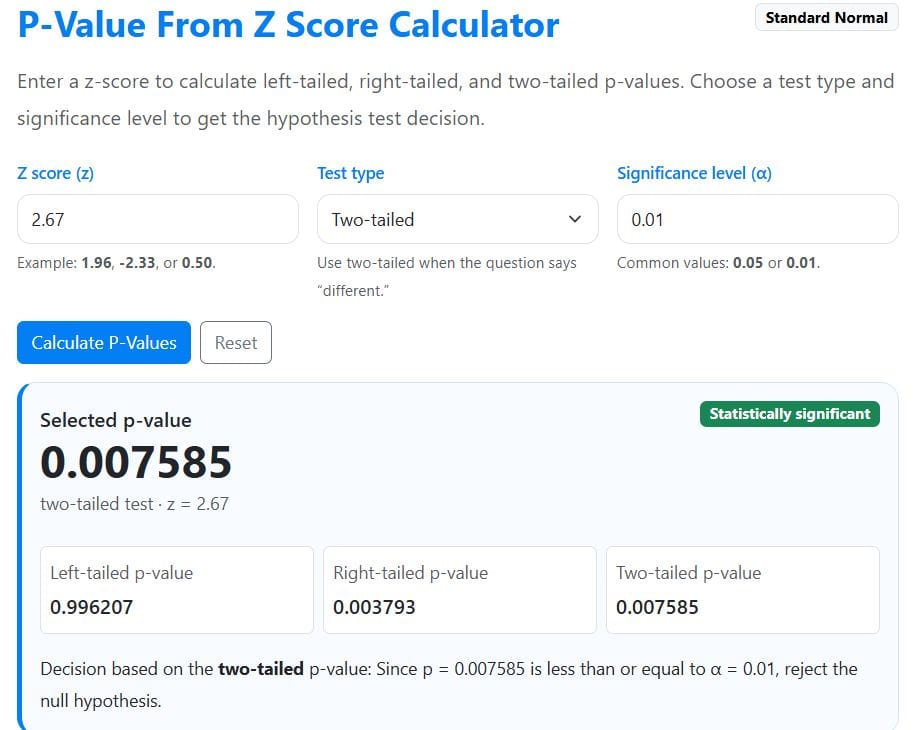
As you can see from the above screenshot, the calculator also compares your p-value with the significance level you entered and gives you the right decision. In this case, it tells you that “Since p = 0.007585 is less than or equal to α = 0.01, reject the null hypothesis.”
Need to Learn the Manual Method? This calculator is designed for quick p-value calculation from a z-score. However, if you want to learn the manual steps, formulas, and z-table method, read our full guide on how to find a p-value from a z-score.
How to Choose Left-Tailed, Right-Tailed, or Two-Tailed P-Value
The correct p-value type depends on the alternative hypothesis. The table below provides a quick way to identify the correct type of test.
| Wording in the question | Symbol in H₁ | Test type |
|---|---|---|
| Less than, lower than, decreased, below | < | Left-tailed |
| Greater than, higher than, increased, above | > | Right-tailed |
| Different from, changed, not equal to | ≠ | Two-tailed |
Note. Do not choose the tail only because the z-score is positive or negative. First, check what the alternative hypothesis is asking.
When to use the z to p-value Calculator
Use this z to p-value calculator when you already have a z test statistic and want to convert it into a p-value.
This calculator is appropriate when the test statistic follows the standard normal distribution. Common examples include:
- One-sample z-tests for the mean (when population standard deviation is known)
- Two-sample z-tests for comparing means when population standard deviations are known
- One-proportion z-tests
- Two-proportion z-tests
- Large-sample hypothesis tests where the sampling distribution is approximately normal
You should not use this calculator when your test statistic is t, F, chi-square, or r. In those cases, use our p-value calculator or the specific p-value calculator for that distribution.
Frequently Asked Questions
A Z to p-value calculator is an online tool that lets you quickly find the p-value for any Z-test. The calculator returns left-tailed, right-tailed, and two-tailed p-values for your test with a click of a button.
Simply enter your Z statistic value, select the test type, enter the significance level and click calculate. The calculator will instantly display the left-tailed, right-tailed, and two-tailed p-values. It will also show you how to find these p-values using a standard normal table, step-by-step.
Yes! Negative Z test statistic values are valid and occur when your sample statistic is below the population mean. The calculator correctly handles negative Z-scores for all test types.
No. A p-value is a probability, so it always ranges from 0 to 1. Our calculator ensures correct calculations for left-tailed, right-tailed, and two-tailed tests. Therefore, you will never see a value greater than 1.
Not necessarily. The calculator gives instant results. However, it also explains how to find p-values manually using Z-tables. This is helpful for learning or verifying calculations for exams and assignments.
